
Every recipe that says "boil water" is quietly assuming you're standing at sea level. Most people never notice, because most people are close enough to sea level that the difference doesn't matter. But move to Denver, Mexico City, or a cabin partway up a mountain, and that assumption starts costing you soggy pasta, runny eggs, and bread that never quite sets right in the middle.
The number everyone memorized in school, 212°F or 100°C, isn't a fixed property of water. It's a property of water at one specific atmospheric pressure. Change the pressure and you change the number. Here's the physics behind why, the real numbers at different elevations, and why it actually matters at the stove and not just on a chemistry test.
The 212°F Number Only Holds at Sea Level
Boiling isn't water getting "hot enough." It's the point where water's vapor pressure, the pressure pushing water molecules to escape into gas, equals the pressure of the air pushing down on the surface. At sea level, standard atmospheric pressure is about 14.7 pounds per square inch, and water needs to hit 212°F before its vapor pressure can match that and start forming bubbles throughout the liquid instead of just evaporating slowly off the top.
That's the whole mechanism. Boiling point isn't a fixed temperature where water "activates." It's a competition between two pressures, and 212°F is just the number where water wins that competition under normal sea-level air.
Most cookbooks, recipe cards, and food packaging print that single number as if it's universal, because for the majority of readers close to sea level, it is close enough to true. The instruction "bring to a boil" works the same everywhere in the sense that you're still watching for the same visual cue: a steady stream of bubbles breaking the surface. What's silently different is the temperature underneath that visual cue, and that's the part a recipe card never tells you.
Why Atmospheric Pressure Is the Actual Variable
Lower the air pressure pushing down on the water, and it takes less vapor pressure, meaning a lower temperature, for water to start boiling. This is the entire reason altitude matters. Atmospheric pressure isn't constant everywhere on Earth. It's highest at sea level, where you have the full weight of the atmosphere above you, and it drops steadily as you gain elevation and there's less air stacked overhead.
This isn't a minor effect that only shows up at extreme heights. Pressure starts dropping the moment you leave sea level, and the boiling point drops right along with it in a predictable, close to linear relationship for the elevations most people actually live or travel at.
What Altitude Does to That Pressure
As a rough rule, atmospheric pressure drops by roughly one inch of mercury for every 1,000 feet of elevation gained, at least through the range most people encounter. That translates to water's boiling point dropping by about 1.8 to 2°F for every 1,000 feet of elevation. It's not a huge number per thousand feet, but it compounds fast in places that are genuinely high up.
The National Weather Service publishes standard atmosphere tables showing exactly how pressure falls off with altitude, and the pattern holds worldwide. It's the same reason airplane cabins have to be pressurized and the same reason your ears pop driving up a mountain pass. Boiling point is just one more downstream effect of the same underlying pressure curve.
The Real Numbers: Boiling Point by Elevation
Sea level: water boils at 212°F (100°C), the number everyone learned.
Denver, roughly 5,280 feet: water boils around 202°F, a full 10 degrees cooler than sea level.
Mexico City, roughly 7,350 feet: closer to 199°F.
La Paz, Bolivia, one of the highest capital cities in the world at nearly 12,000 feet: down around 188 to 190°F.
The summit of Everest, at over 29,000 feet: water boils at roughly 160°F, cool enough that you genuinely cannot make a proper cup of tea up there no matter how long you wait. Boiling point as a concept scales with pressure for any liquid, not just water, which is worth keeping in mind for later.
Why This Actually Matters at the Stove
A 10-degree drop sounds small until you realize boiling water is the ceiling, not a target you're missing by a little. At sea level, boiling water is 212°F no matter how hard you crank the burner. In Denver, boiling water tops out at 202°F, permanently, and no amount of extra heat pushes it higher. The water just boils more vigorously; it doesn't get hotter.
That ceiling is why high-altitude cooking instructions exist at all. Pasta cooked in 202°F water instead of 212°F water takes measurably longer to reach the same doneness, because the cooking is a function of temperature over time, and the temperature available to you is simply lower. Eggs behave the same way. A "perfect soft-boiled egg, 6 minutes" timer calibrated at sea level will underconvert at altitude, because six minutes at 202°F does less to the egg white than six minutes at 212°F.
The usual fix people reach for is just "cook it longer," and that works, but only if you know roughly how much longer, which depends on knowing how far your actual boiling point has dropped. Guessing at that number tends to produce either undercooked pasta from someone who added two extra minutes when they needed six, or badly overcooked pasta from someone who overcorrected because they weren't sure and erred on the side of more time. Neither is necessary once you know the real number for your elevation instead of a vague sense that "things take longer up here."
Baking Is Where the Physics Gets Expensive
Boiling water problems are annoying but fixable by adding a few minutes. Baking problems are worse, because altitude changes more than one variable at once. Lower atmospheric pressure means gases inside batter, both the air you mixed in and the carbon dioxide from leavening, expand more before the structure has set. Cakes and quick breads can over-rise and then collapse before the crumb is strong enough to hold its shape.
Water also evaporates faster at altitude because of that same lower pressure, which concentrates sugar and can throw off the structure of anything relying on precise hydration. King Arthur Baking and most extension services with high-altitude guides recommend a standard set of adjustments above roughly 3,000 feet: slightly less sugar and leavening, slightly more liquid, and a slightly higher oven temperature to help the structure set before the rise gets away from the recipe. None of that is guesswork once you understand that pressure, not just temperature, is doing the damage.
It's Not Just Water: Other Substances Follow the Same Rule
Boiling point depression from lower pressure isn't unique to water. Every liquid has a boiling point that's defined relative to the pressure around it, which is why NIST and other standards bodies always publish boiling points alongside the pressure condition they were measured at, usually standard atmospheric pressure, rather than as a single unqualified number.
This matters for anyone doing more than casual cooking at altitude. Alcohol, with a much lower boiling point than water to begin with, boils off noticeably faster in a simmering sauce at elevation. Canning and preserving instructions change at altitude for the same reason, since the processing temperatures the recipes assume are calibrated to sea-level boiling. Home canners at elevation are typically told to increase processing time or pressure specifically because a lower boiling point means less heat is reaching the jar's contents in the same amount of time, and undercooked preserved food is a real safety issue, not just a texture one.
If you're working from a recipe or a lab procedure written at sea level and you're not at sea level, the temperature it assumes isn't the temperature you're actually getting. That gap is easy to overlook because nothing about the recipe looks wrong on the page. The numbers are just quietly calibrated for somewhere else.
Reading a Recipe Written for a Different Elevation
A lot of altitude cooking frustration comes from a mismatch nobody flags explicitly. A recipe developed and tested in a sea-level test kitchen, which describes most published cookbooks and food blogs, bakes its assumptions about boiling point and evaporation rate directly into the timing without ever stating them. There's rarely a line that says "developed at sea level," so the recipe reads as universal even though it was only ever tested under one specific pressure.
The practical workaround isn't to distrust every recipe you didn't write yourself. It's to treat stated cook times as a starting estimate rather than a guarantee whenever you know you're significantly above sea level, and to check doneness by the actual indicators the recipe describes, texture, color, a thermometer reading, rather than the clock alone. Boiling and simmering steps are the ones most worth double checking, since they're the steps most directly tied to the pressure-dependent temperature ceiling covered above.
How to Stop Guessing and Just Calculate It
The relationship between elevation and boiling point is predictable enough to calculate directly instead of estimating from memory or a rough rule of thumb. That's what the free boiling point calculator from EvvyTools does: enter your altitude, or the city you're cooking in, and it returns the actual boiling point of water at that elevation, along with adjustments for a handful of other common substances. There's also a set of high-altitude cooking presets built in, so instead of hunting down a generic rule of thumb, you get the actual number for where you are.
It sits alongside the rest of the calculators in the EvvyTools tools directory, most of which follow the same idea: take a piece of physics or math that people usually estimate roughly, and give them the real number instead.
The Takeaway
212°F was never a universal truth about water. It's what happens at one specific atmospheric pressure, and that pressure changes the moment you change elevation. Once you know your actual boiling point, a lot of altitude-related cooking mysteries stop being mysteries: why the pasta takes longer, why the cake collapsed, why the recipe from a sea-level cookbook needed adjusting in the first place.
If you live or frequently cook somewhere well above sea level, it's worth running your elevation through the calculator once and keeping the number in mind rather than re-deriving it from a rule of thumb every time. More breakdowns like this one, focused on the specific math behind everyday questions, live on the EvvyTools blog.
 Photo by Luke Miller on Pexels
 Photo by Ahmad Taba on Pexels
 Photo by Ana Zanuto on Pexels
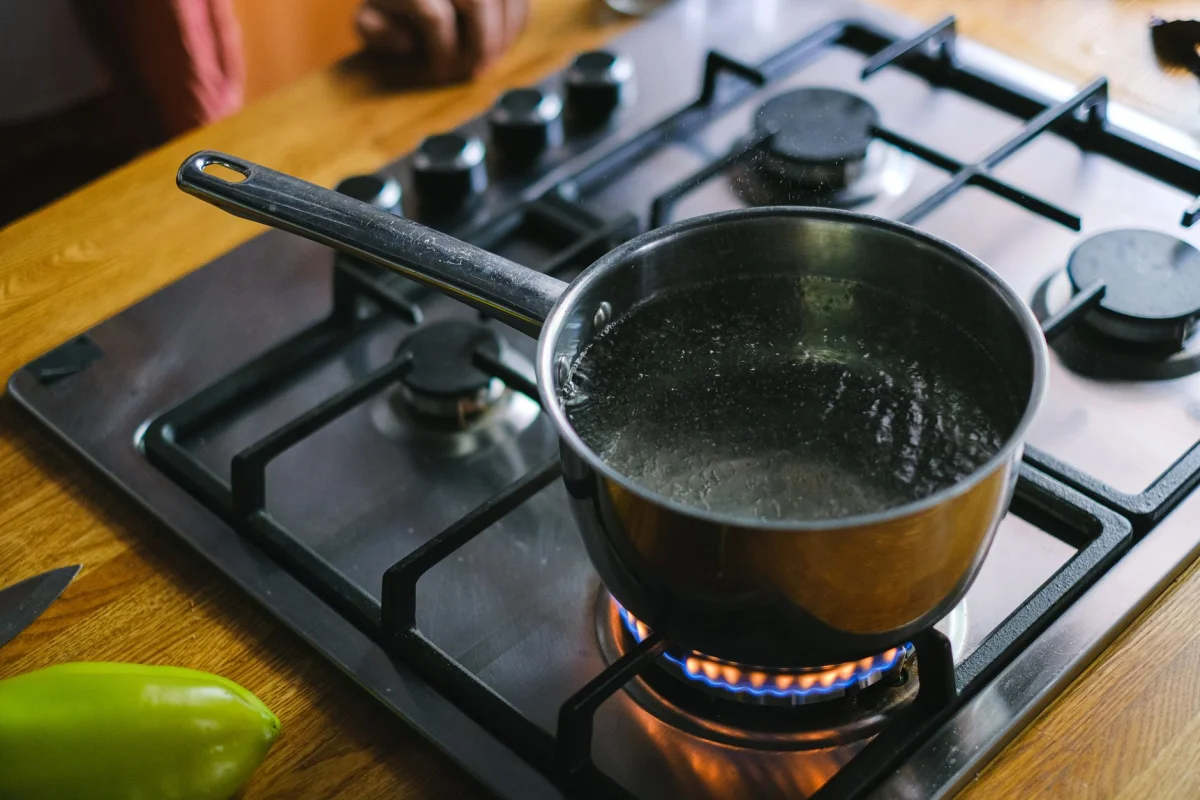
 Photo by Ulrick Trappschuh on Pexels