You're hosting six people instead of the usual three, so you pull up a recipe written for three and multiply everything by two. Flour, sugar, butter, eggs, all doubled. The cake goes in the oven at the same temperature for what seems like a reasonable extra ten minutes, and comes out with a sunken middle and a scorched top.
Nothing about the multiplication was wrong. Two times every number is still two times every number. The problem is that a recipe isn't a single ratio scaled uniformly. It's several different kinds of math stacked on top of each other, and only some of them behave the way doubling assumes they will.
The Ingredients That Actually Do Scale Linearly
Most of what's in a mixing bowl really does scale in a straight line, and it's worth being clear about that before getting into the exceptions. Flour, sugar, liquids, and fats all scale proportionally to batch size because their job is to make up the bulk of the dish. If a soup recipe needs twice the volume, it needs roughly twice the broth, twice the vegetables, and twice the protein.
This is the part of recipe math most people already do correctly in their heads, which is exactly why the exceptions catch them off guard. The mistake isn't miscalculating the easy 90 percent. It's assuming the other 10 percent follows the same rule.
 Photo by Olesia malhcuk on Pexels
Salt, Spices, and Seasoning Don't Scale the Same Way
Taste perception isn't linear, and that's the first place doubling quietly goes wrong. Doubling the batch doesn't mean the dish needs to taste twice as salty or twice as spicy, because the human palate doesn't register intensity on a straight line. A soup that used a teaspoon of salt for four servings usually needs less than two teaspoons for eight, not because the math changes but because concentration and perceived intensity aren't the same thing.
This matters most with potent seasonings: chili flakes, cayenne, strong herbs like rosemary, and anything with a sharp, dominant flavor. The safer move when scaling up is to add roughly 75 to 85 percent of the linear amount, taste, and adjust from there. You can always add more salt. You can't take it back out.
Leavening Agents Have a Ceiling
Baking soda and baking powder are the clearest case of an ingredient that flatly refuses to scale with everything else. These aren't flavor ingredients, they're chemical reactions, and chemical reactions don't get proportionally stronger just because there's more batter around them.
Double a cake recipe's baking soda along with everything else and the result is often a soapy, metallic aftertaste along with an odd, coarse crumb, because there's now too much alkaline leavening agent relative to what the batter can neutralize through baking. The Wikipedia entry on leavening agents is a decent starting reference for why these compounds behave the way they do at a chemical level. As a practical rule, when scaling a recipe up by more than 50 percent, increase leavening agents by a smaller fraction than everything else, closer to three-quarters of the proportional amount, and rely on baking time and visual cues rather than assuming the original ratio still applies.
Pan Size and Cooking Time Scale by a Different Rule Entirely
This is where most doubled-recipe disasters actually happen, and it has nothing to do with ingredient ratios. It's geometry. When you double a batch of cake batter and pour it into a pan that's proportionally larger, you're not just changing volume, you're changing the ratio of surface area to volume, and that ratio is what actually determines cooking time.
A cake pan twice the diameter doesn't hold twice the batter at the same depth, it holds roughly four times as much, because area scales with the square of the radius while the batter's depth (and therefore how long heat takes to reach the center) scales differently again. That's why a doubled cake batch poured into a same-shape-but-bigger pan often needs a longer bake at a slightly lower temperature, not the same temperature for a modestly longer time. King Arthur Baking publishes pan-size conversion guidance that's a genuinely useful reference here, because getting this wrong is the single most common reason a scaled-up baking recipe fails even when every ingredient ratio was calculated correctly.
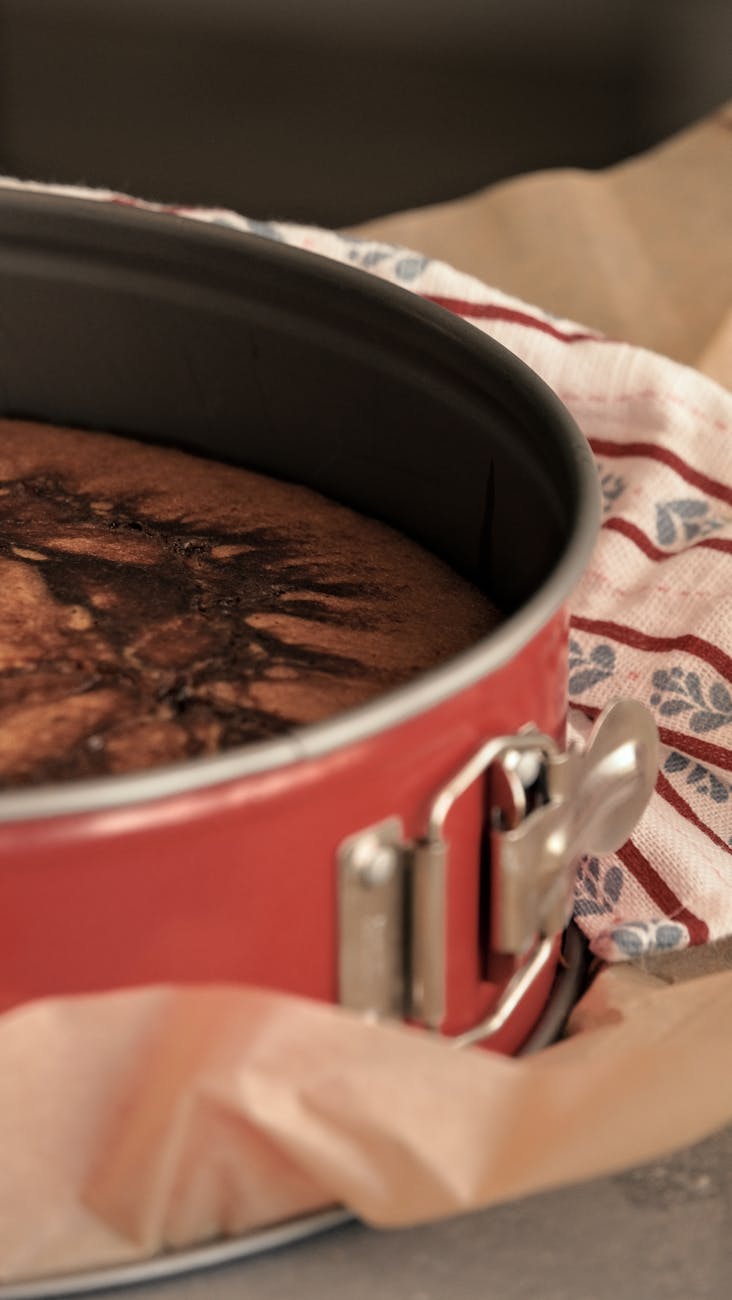 Photo by Merve on Pexels
Why Fractions Get Ugly Fast
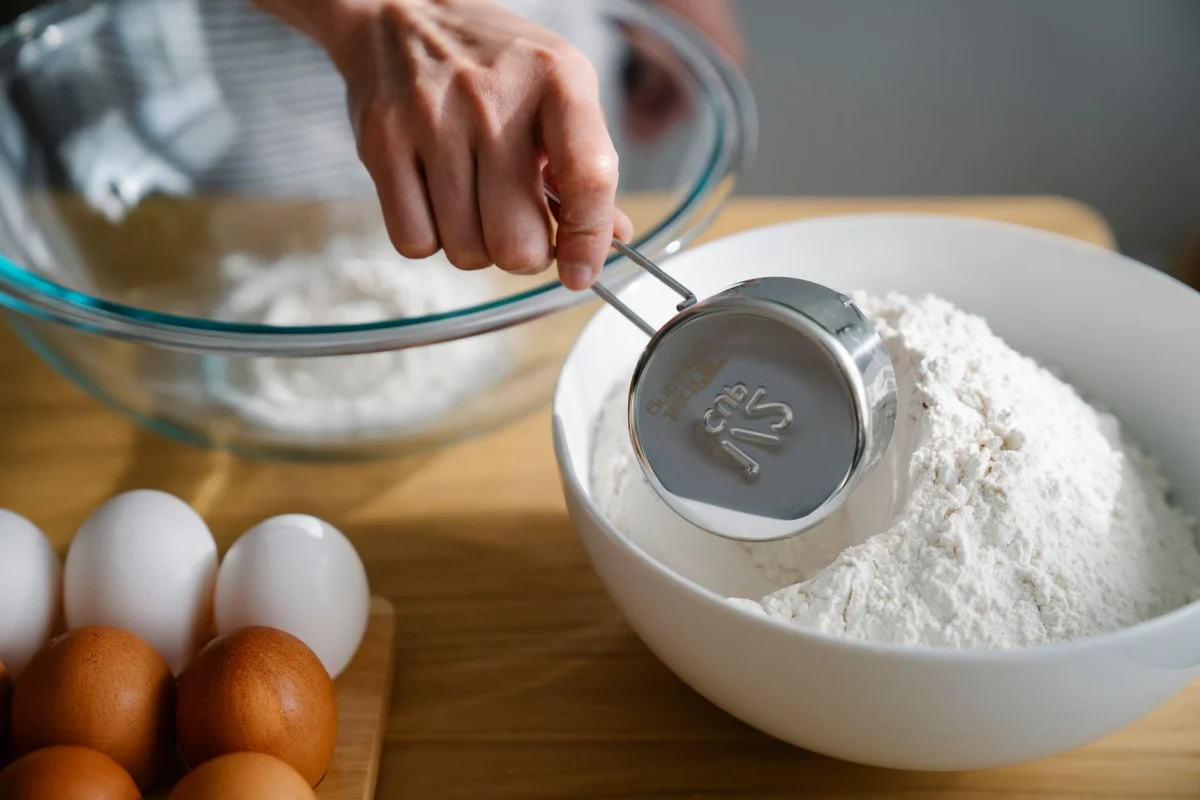
Even when the math is straightforward, the practical side of scaling creates its own problem: fractions that don't correspond to anything on a measuring spoon. A recipe that calls for a third of a cup, scaled by 1.5, becomes exactly half a cup, which is clean. Scaled by 1.75, it becomes a number nobody wants to eyeball with a set of standard measuring cups.
This is where kitchen-friendly rounding earns its keep. A tool that just does the raw multiplication and hands back 0.583 cups isn't actually helpful, because no measuring cup in a standard set reads 0.583. What's useful is rounding to the nearest practical increment, an eighth of a cup or a quarter teaspoon, the way an experienced cook would round it by feel. NIST maintains the underlying weights-and-measures standards that most kitchen conversions ultimately trace back to, though in practice almost nobody scaling a soup recipe on a Tuesday night is thinking about metrology. They're thinking about not dirtying a fourth measuring spoon.
Metric Conversion Adds Its Own Layer
Scaling a recipe and converting it between imperial and metric units are two separate problems that often show up at the same time, especially with recipes sourced from international sites. Volume-based imperial measurements (cups, tablespoons) don't convert to metric weight cleanly because ingredient density varies. A cup of packed brown sugar and a cup of sifted flour don't weigh the same amount, so a single conversion factor across an entire recipe introduces error before scaling even starts.
Professional and serious home bakers increasingly measure by weight rather than volume specifically because it sidesteps this problem, and weight-based scaling is genuinely linear in a way volume-based scaling for ingredients like flour usually isn't, since packed density varies with how the flour was measured. The USDA publishes food composition and density data that underlies a lot of the volume-to-weight conversion tables used across cooking apps and reference sites.
Scaling Down Has Its Own Quirks
Halving a recipe gets less attention than doubling it, but it breaks in ways that are just as predictable once you know where to look. Cooking a smaller batch usually means a shorter cook time, but not always in direct proportion, because a thinner layer of food in a pan loses moisture faster than a thicker one and can dry out before the center of a larger version would even be close to done.
Eggs are the classic halving headache. A recipe built around two eggs doesn't cleanly become one egg for a half batch, and it definitely doesn't become half an egg for a quarter batch. Cracking one egg into a bowl, whisking it, and measuring out half by volume is a workable fix, but it's the kind of extra step that raw multiplication doesn't warn you about in advance.
Small-batch baking runs into the same pan-geometry issue as scaling up, just in reverse. A halved cake batter poured into a proportionally smaller pan still needs watching rather than a clock cut exactly in half, because the surface-area-to-volume relationship that changes cooking time when you scale up changes just as much when you scale down.
A Practical Framework for Scaling by Hand
If you're scaling a recipe without a calculator, a few rules of thumb get you most of the way to a reliable result:
- Bulk ingredients (flour, sugar, liquid, most vegetables and proteins): scale linearly, no adjustment needed.
- Salt and strong seasoning: scale to about 75-85 percent of the linear amount, then taste and adjust.
- Leavening agents (baking soda, baking powder, yeast): scale to about 75 percent of the linear amount for increases over 50 percent, and watch the result rather than trusting the ratio.
- Cooking and baking time: don't assume it scales at all. Check doneness with a thermometer or toothpick rather than a clock, especially for anything baked in a differently sized pan.
- Pan size: match volume, not just diameter or length. A pan twice as wide can hold roughly four times the batter at the same depth.
None of these rules require memorizing ratios. They require knowing which category an ingredient falls into before you reach for the calculator.
 Photo by Derya Nur 🕊️ on Pexels
Where a Recipe Scaling Tool Actually Helps
The linear-ingredient math is easy enough to do in your head or on a napkin. Where a dedicated tool earns its place is everything after that: converting between fractions and practical kitchen measurements without landing on 0.583 cups, handling the imperial-to-metric conversion without losing accuracy to volume-versus-weight density differences, and rounding the result to something you'd actually find on a measuring spoon instead of a raw decimal.
The free Recipe Scaler by EvvyTools takes a recipe's original quantities, scales them up or down by whatever factor you need, and rounds the output to practical kitchen increments automatically, while supporting conversion between imperial and metric units. It won't tell you to hold back on the baking soda or watch the pan instead of the clock, that part is still on you, but it removes the part of scaling that's just tedious arithmetic so you can focus on the parts that actually require judgment.
For more free kitchen and everyday calculators like this one, browse the EvvyTools tools directory, or check the EvvyTools blog for more breakdowns of the math hiding behind everyday tasks. You can also start from the EvvyTools homepage to see the full catalog of free tools.