A neighbor plants a maple sapling in April, waters it every evening for two weeks, then gets busy and forgets about it for a month. By August the leaves are curling and browning at the edges. This isn't bad luck. It's the single most common way homeowners lose a young tree, and it has almost nothing to do with effort and everything to do with not knowing how much water the tree actually needs.
Most people either guess or default to whatever the hose does in ten minutes. Neither approach accounts for the variables that actually matter: how thick the trunk is, whether the tree is newly planted or established, what kind of soil it's sitting in, and what the weather has been doing lately. Get those four things roughly right and tree watering stops being a mystery.
Why Tree Watering Is Trickier Than It Looks
Lawns are forgiving. If you underwater grass for a week, it goes dormant and bounces back with the next rain. Trees don't work that way. A mature tree has an enormous root system that draws water from a wide area, while a newly planted tree has almost no root spread at all and depends entirely on the small area you actually soak.
That mismatch is why so many new trees die in their first two summers even when the homeowner swears they watered "plenty." The water went where the hose was pointed, not necessarily where the roots could reach it. Understanding trunk diameter, root spread, and establishment stage together is what turns guessing into a workable schedule.
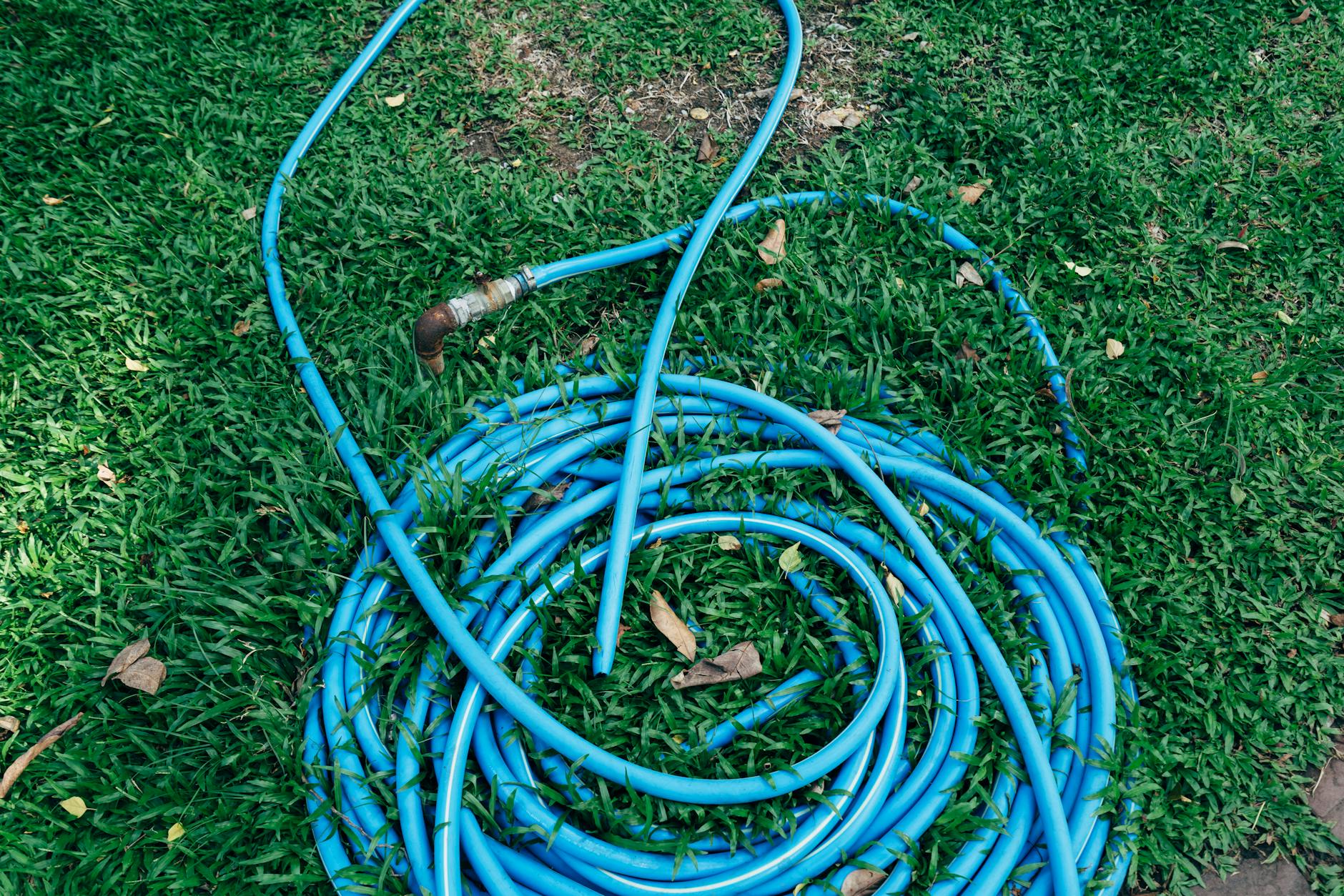 Photo by Markus Winkler on Pexels
The Baseline Arborists Actually Use
Professional arborists rely on a simple rule of thumb: about 10 gallons of water per inch of trunk diameter, measured at knee height, per watering session. A tree with a 2 inch trunk gets roughly 20 gallons. A tree with a 6 inch trunk gets roughly 60 gallons.
That number isn't arbitrary. It roughly matches how much water a tree's root zone can absorb before runoff starts, which is also why slow, deep watering beats a quick daily splash. The Wikipedia entry on transpiration is a good primer on why trees lose water constantly through their leaves and need deep root reserves to keep up, especially in hot, dry, or windy weather.
New Trees vs Established Trees: Different Rules
The First Two Years Matter Most
A newly planted tree hasn't grown roots beyond its original root ball yet, so it's entirely dependent on you for water during its first one to two growing seasons. This is usually called the establishment period, and it's the window where most preventable tree deaths happen.
During establishment, that 10 gallon per inch baseline typically gets applied two to three times a week in the growing season, tapering as the tree shows new growth and the root system spreads outward. Once a tree is established, usually by year two or three depending on species and site conditions, natural rainfall covers most of its needs and supplemental watering becomes a dry spell backup rather than a routine.
Species Water Needs Vary More Than People Expect
A river birch or willow wants consistently moist soil and will show stress quickly in a dry stretch. Many oaks, once established, tolerate drought reasonably well because they send roots deep. Matching your watering plan to the species, not just the trunk size, is why two trees planted the same week can need very different schedules.
How the Season Changes the Math
Spring
Spring rainfall often covers most of a tree's needs, but a warm dry stretch in April or May can catch people off guard, especially with trees planted the previous fall that are still establishing.
Summer
Summer is when most watering actually happens. Heat and longer daylight hours increase transpiration, so even established trees can show stress during extended dry periods, and new trees need close attention on a fixed schedule rather than a "check when I remember" approach.
Fall
Watering doesn't stop when temperatures drop. Trees are still building root mass into fall, and a well hydrated tree going into winter handles cold stress and winter windburn considerably better than a drought stressed one.
Winter
In regions with mild, dry winters, evergreens especially can benefit from an occasional deep watering during a warm, dry stretch. In snowy climates this mostly isn't necessary since the ground is typically frozen or well insulated by snow cover.
 Photo by Alexey Demidov on Pexels
Reading the Signs: Overwatering vs Underwatering
Drought Stress Signals
Leaves that curl, wilt in the afternoon heat, or turn brown and crispy at the edges are classic underwatering signs. On evergreens, needles that turn yellow or drop earlier than expected are worth investigating. Scratch a small patch of bark near the base; if the wood underneath is dry and brittle rather than moist, it's a good sign the root zone has dried out too.
Overwatering Signals
Overwatering is quieter and easier to miss. Yellowing leaves across the whole canopy rather than just the edges, a persistently soggy area at the base, fungal growth on the mulch, or a tree that just looks generally unhealthy despite frequent watering can all point to waterlogged roots that are suffocating rather than thirsty. Soil that never dries out between waterings is the biggest tell.
Soil Type Changes Everything
Sandy soil drains fast and needs more frequent watering in smaller amounts. Clay soil holds water much longer and is where overwatering tends to happen, since the same watering frequency that works for sandy soil can leave clay saturated for days. A Rutgers Cooperative Extension office or your local university extension program is usually the fastest way to get a straight answer on your specific soil type and how it changes local watering recommendations.
How to Apply the Water So It Actually Reaches the Roots
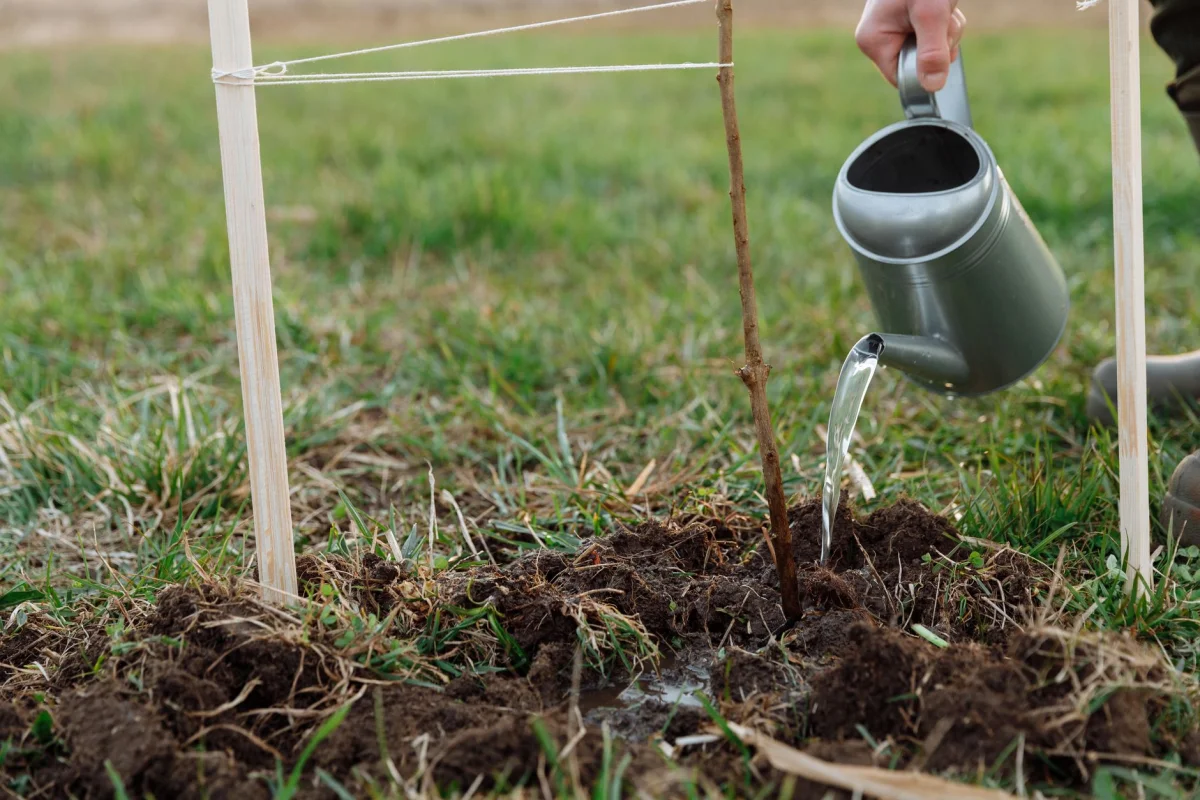
Getting the gallon number right doesn't help much if the water runs off into the lawn instead of soaking into the root zone. For new trees, a slow release watering bag or gator bag wrapped around the trunk is one of the simplest fixes, since it drips water directly over the root ball for several hours instead of dumping it all at once. A soaker hose coiled loosely around the tree's dripline, the outer edge of the canopy, works well for slightly larger or partially established trees.
If you're using a regular hose, turn the flow down to a slow trickle and move it every few minutes rather than blasting a full stream at the base for thirty seconds and calling it done. A quick soil check helps confirm you actually got there: push a long screwdriver or a thin metal rod into the ground near the root zone. It should slide in fairly easily through moist soil and meet noticeably more resistance once it hits dry ground, which gives you a rough sense of how deep the water actually penetrated.
 Photo by Uğur Salık on Pexels
Rainfall: Do the Math Before You Turn On the Hose
A common mistake is watering on a fixed schedule regardless of what the sky has already done. An inch of rainfall roughly delivers 600 gallons per 1,000 square feet of ground, which is often enough to skip a scheduled watering entirely for an established tree. Checking a rain gauge before defaulting to the hose saves water and avoids the overwatering trap described above. The EPA WaterSense program has useful, practical guidance on outdoor water efficiency if you want to go deeper on this.
 Photo by revac film's&photography on Pexels
A Simple Way to Get the Right Number
Running trunk diameter, establishment stage, species, season, soil type, and recent rainfall through a mental checklist every time you water is a lot to track, which is why most people either overwater out of caution or underwater out of forgetfulness. We built the Tree Watering Calculator to do that math for you: enter your trunk size, establishment stage, species water need, season, soil type, and recent rainfall, and it returns a straight gallons-per-week target using the same 10 gallon per inch baseline arborists use, along with an optional 12 month watering plan and cost estimate.
It's not a substitute for watching your actual tree, but it takes the guesswork out of "is this enough" and gives you a concrete number to work from.
Common Mistakes Homeowners Make
Shallow, frequent watering trains roots to stay near the surface instead of growing deep, which makes a tree more vulnerable in dry spells. Watering the trunk directly instead of the surrounding root zone wastes most of the water on runoff. Skipping fall watering because "it's not hot anymore" leaves trees under-prepared for winter. And treating every tree the same regardless of species or soil type is probably the single biggest reason watering schedules fail.
Mulching around the base, 2 to 4 inches deep and kept a few inches back from the trunk itself, helps retain soil moisture and reduces how often you need to water in the first place. The USDA Forest Service and the Arbor Day Foundation both publish solid, free guidance on planting and establishment care if you want more detail on tree biology beyond watering specifically.
Quick Reference Checklist
Use roughly 10 gallons per inch of trunk diameter per watering session. Water new trees two to three times a week during their first one to two growing seasons. Water deeply and slowly rather than briefly and often.
Adjust for species, checking whether yours prefers consistent moisture or tolerates dry spells once established. Factor in recent rainfall before defaulting to the hose. Keep watering into fall, tapering off only as the ground begins to freeze.
Getting tree watering right isn't complicated once you know the variables that matter. It just takes a little more thought than pointing a hose at the base and hoping for the best. For more home maintenance guides and tools like this one, visit the EvvyTools blog or browse the full tools directory for other free calculators, or head back to the EvvyTools homepage to see what else is there.