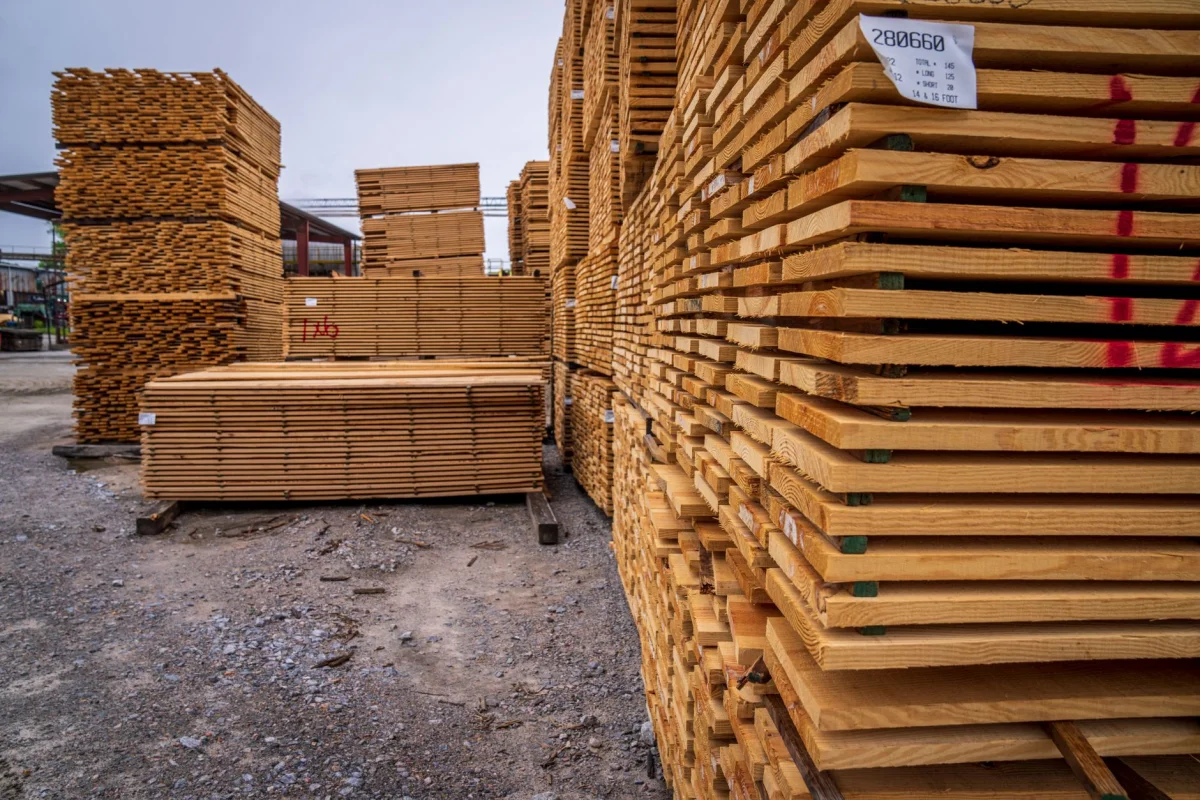
Run a project through a board foot calculator and you get a clean number. Forty-two board feet of white oak, say, for a set of cabinet doors. That number is correct as far as it goes, but it answers a narrower question than most people think: how much finished wood the design needs, not how much lumber to actually buy. Order exactly 42 board feet and there is a good chance the project runs short before the last cut is made.
The gap between the design number and the order number is where a lot of first-time lumber buyers get burned. Defects, saw kerf, and the simple fact that boards don't come in the exact lengths a cut list wants all eat into the raw total. None of that is a flaw in the calculator. It is just a different question than the one it was built to answer.
What a Board Foot Calculator Actually Measures
A board foot is a volume measurement, one square foot of wood one inch thick, and a calculator multiplies length, width, and thickness to get that volume for a given board. The free Board Foot Calculator from EvvyTools does exactly that, along with pricing out species and converting between nominal and actual dimensions so you aren't accidentally measuring a rough-sawn board as if it were already planed smooth.
That output describes the wood a finished project consumes, assuming every cut lands perfectly and every board is clean, straight stock with no waste anywhere. It is a measurement of material in the finished piece, not a prediction of how much raw lumber you need to buy to get there.
Treating the calculator's output as a shopping list is the single most common reason DIY lumber orders come in short. The number is accurate. It's just answering "how much wood ends up in the project" rather than "how much wood should I buy."
Defects You Can't See Until the Board Is Milled
 Photo by Brett Sayles on Pexels
Lumber grading rules, like the ones published by the National Hardwood Lumber Association, allow a certain percentage of defects, knots, checks, and wane, even within a given grade. A board that passes grading can still have a knot sitting exactly where your cut list needs clean, straight grain.
You usually can't see this until the board is actually on the saw. A knot near one end might be fine for a short shelf cleat and a dealbreaker for a long rail that needs to be defect-free its whole length. Buying the exact board footage with no margin assumes every single board you receive is perfect for its intended cut, which almost never happens in practice.
Rough lumber especially hides problems. Checking, which is splitting along the grain as wood dries, can run several inches into a board end and isn't always visible until you cut past the first few inches. Budgeting for some percentage of unusable material up front is cheaper than discovering it mid-project and making an emergency run to the yard.
Kerf Loss: What Every Cut Actually Costs You
Every cut a saw makes removes a thin slice of wood as sawdust, called the kerf, and that material is gone for good. A typical table saw blade removes somewhere around an eighth of an inch per cut, which sounds trivial until you count how many cuts a real project involves.
Rip a single board into four narrower pieces and you've lost three kerf widths worth of material compared to the theoretical yield if the saw cut with zero width. On a large project with dozens of rips and crosscuts, that adds up to real board footage that a calculator's clean volume math never accounted for, because it has no way of knowing your cut sequence in advance.
Resawing makes this worse. Splitting a thick board into two thinner ones for bookmatched panels can lose a surprising fraction of the material to kerf and to the planing needed afterward to clean up both faces. If your plan includes resawing, pad the estimate more than you would for straightforward crosscuts and rips.
Grain and Color Matching Eats Into Your Buy
 Photo by FWStudio on Pexels
Visible projects, a tabletop, a set of cabinet doors, anything where adjacent boards sit side by side in plain view, need boards that match reasonably well in color and grain pattern. That requirement quietly shrinks your usable pile, because not every board in an order will match the others closely enough to use together.
This is where buying a tight quantity backfires hardest. If you need six matching boards for a tabletop and order exactly six board feet worth, you have zero flexibility to reject a board that's noticeably lighter or has wilder grain than the rest. Ordering extra gives you a selection to choose from instead of forcing you to use whatever shows up.
Species with high natural variation, like walnut with its range from pale sapwood to deep brown heartwood, need a bigger matching buffer than something more uniform like hard maple. Factor the species' own variability into how much extra you order, not just a flat percentage across every project.
Species and Grade Change the Right Waste Percentage
A clear, high grade of a stable domestic species like hard maple or poplar can often get by with a modest waste allowance, since defects are rarer and the wood works predictably. Lower grades, exotic or highly figured species, and anything prone to warping or checking during drying deserve a bigger cushion.
The USDA Forest Products Laboratory publishes research on how different species behave during drying and machining, and it's a useful reference if you're working with a species you haven't used before and want a sense of how much it tends to move or check. Species with more aggressive seasonal wood movement are generally the ones that need a larger waste buffer.
Grade matters just as much as species. A board that's graded one step down from select will have more knots and shorter clear sections between defects, which means more offcuts and more rejected pieces per board foot purchased. If your project design is flexible on grade, dropping one grade level and ordering more volume can sometimes cost less overall than buying a higher grade at a tighter quantity.
A Simple Formula for Building In a Waste Factor
The practical fix is straightforward: take the calculator's board foot total and multiply it by a waste factor before placing the order, rather than ordering the raw number. A common starting range is 15 to 20 percent for straightforward projects in a stable, clear-grade species, climbing to 25 to 30 percent for projects with heavy color matching requirements, resawing, or a lower grade of lumber.
Written out, it looks like this: order quantity equals the calculator's board foot total multiplied by one plus the waste factor. Forty-two board feet at a 20 percent waste factor becomes just over 50 board feet to actually order, which is the number you bring to the lumber yard or type into a supplier's quote request, not the original 42.
There's no single correct percentage that applies to every project. The right number depends on the defect rate of the grade you're buying, how many cuts the design requires, and how demanding the visible grain matching is. Treat the ranges above as a starting point to adjust from, not a fixed rule.
Running the Numbers on a Real Project
 Photo by Markus Winkler on Pexels
Say a cabinet door project calls for 42 board feet of select white oak by the finished cut list. The doors are a visible, matched-grain application, there's a moderate amount of ripping involved, and select grade still carries a small percentage of minor defects per the grading rules. A 25 percent waste factor fits that profile reasonably well.
Forty-two board feet times 1.25 comes out to 52.5 board feet, which rounds up to 53 for an actual order. That's roughly 11 extra board feet over the calculator's raw output, bought specifically to cover the grain matching, the kerf from ripping stiles and rails, and a reasonable allowance for rejecting a board or two that doesn't match the rest.
Running the same cut list again as simple shop shelving in poplar, with no visible matching requirement and far fewer rip cuts, might only justify a 10 to 15 percent waste factor. Same calculator output, same base math, a meaningfully different order quantity because the application changes what the wood actually has to deliver.
When to Round Up and When Exact Is Fine
Rounding up matters more on one-time projects where a second trip to the yard means buying from a different batch that may not match the first, especially with species like walnut or cherry that vary noticeably board to board. For those projects, erring toward the higher end of a waste factor range costs little extra and avoids a real headache.
On the other end, standardized dimensional lumber bought from a big box store for a simple framing or utility project doesn't need the same cushion. Studs and construction-grade lumber are produced to tighter, more consistent tolerances, and color matching usually isn't a concern since the wood gets covered or painted. A smaller waste factor, closer to 10 percent, is often enough.
The deciding question is simple: how expensive and disruptive is running short partway through, versus how expensive is a modest amount of leftover material. Visible, hard-to-match hardwood projects weigh heavily toward buying more. Utility lumber for a project where offcuts are genuinely useful scrap weighs toward buying closer to the calculator's raw number.
Putting It Together Before You Call the Yard
Start with an accurate board foot total from the cut list, not a rough guess at dimensions. Then pick a waste factor based on three things: the grade and species you're buying, how much ripping and resawing the project requires, and how demanding the visible grain or color matching is going to be.
Multiply the raw total by one plus that waste factor to get the number you actually bring to the supplier. It will almost always be higher than what a calculator alone reports, and that gap is the real cost of defects, kerf, and selection, not an error in the math.
For more free calculators like this one, covering everything from material estimates to project budgeting, the EvvyTools tools directory is worth a browse, and the blog hub has more deep dives like this one if you're planning a bigger build. A little extra lumber on the truck is always cheaper than a second trip mid-project, and now there's a real number behind how much "a little extra" should actually be.