


Every runner has stood at a start line with a number in their head: a goal time, a pace they think they can hold, a plan that feels solid in the parking lot. Then the gun goes off, adrenaline takes over, and that first mile comes in twenty seconds faster than intended. It feels fine. It is not fine. It is the first domino in a chain that ends with a walk-jog finish and a results page that does not match the training log.
Pace is the one number that actually determines whether a race goes the way it was supposed to. Fitness gets a runner to the start line in shape to run a certain time, but pacing is what decides whether that fitness gets spent evenly across the distance or blown in the first five miles. The math behind it is not complicated, but it has to be done before race day, not improvised during it.
Why Pace Matters More Than Raw Fitness on Race Day
Two runners with identical fitness levels can finish a marathon fifteen minutes apart based on pacing alone. The one who starts conservatively and finishes strong almost always beats the one who starts fast and fades, even though both burned roughly the same amount of energy over 26.2 miles. Fading costs more time than starting slow ever will, because a body running on fumes in the final miles loses far more per mile than a controlled early pace ever gains.
This is why coaches obsess over goal pace weeks before a race instead of leaving it to feel. A runner who knows exactly what 8:15 per mile should feel like at mile 3, mile 13, and mile 22 can self-correct in real time. A runner who is just "running comfortably hard" has no reference point when things start to go sideways around mile 18.
 Photo by zheng liang on Pexels
How to Calculate Pace From Time and Distance
The core formula is simple division: pace equals total time divided by total distance. A runner who covers a 10K (6.2 miles) in 55 minutes is running an 8:52 per mile pace, calculated by dividing 55 minutes by 6.2 miles. Flip the formula to solve for finish time instead: multiply target pace by total distance, so an 8:00 per mile pace over a half marathon (13.1 miles) projects to a 1:44:48 finish.
The tricky part is converting the decimal remainder into seconds correctly. Dividing 55 by 6.2 gives 8.87, and the temptation is to read that as "8 minutes 87 seconds," which does not exist. The 0.87 has to be multiplied by 60 to get 52 seconds, landing on 8:52. Doing this by hand for every mile split adds up to real arithmetic errors, which is exactly the kind of repetitive conversion a free pace and race time calculator from EvvyTools is built to handle instantly instead of leaving room for a decimal mistake mid-plan.
Converting Between Minutes-Per-Mile and Minutes-Per-Kilometer
American racers train in minutes per mile; most GPS watches default to that unit, and most US road races post mile markers. But plenty of race apps, international events, and training plans built around VDOT tables use minutes per kilometer instead, and the two units are not close enough to eyeball. A mile is 1.60934 kilometers, so a pace of 8:00 per mile converts to roughly 4:58 per kilometer, not 5:00 as a quick mental estimate might suggest.
Runners who train on a treadmill set to kilometers but race a mile-marked course need to do this conversion before race week, not while standing at mile marker 4 wondering why the pace on their watch looks wrong. Writing both units on a wrist card or pace band eliminates the mental math entirely on race day, when working memory is already spent on effort and fueling.
Building a Mile-by-Mile Split Table for Race Day
A split table is just the goal pace applied cumulatively to every mile marker on the course. For a 4:00:00 marathon goal at 9:09 per mile, mile 1 should read 9:09, mile 10 should read roughly 1:31:30, and mile 20 should read roughly 3:03:00. Having these numbers written down, either on paper or loaded into a GPS watch, turns "am I on pace" from a guess into a glance.
The value of a split table is not the finish-time prediction, it is the checkpoints along the way. A runner who hits mile 6 forty seconds ahead of goal pace has useful information: back off slightly rather than bank the time, because banking time early in a race almost always gets spent with interest later. Splits catch pacing drift while there is still time to correct it.
 Photo by Burst on Pexels
Even Splits vs. Negative Splits: Which Strategy Actually Works
An even split means running every segment of the race at roughly the same pace. A negative split means running the second half faster than the first. Race analytics consistently show that negative-split and even-split finishers outperform positive-split finishers (those who slow down) at every distance, and that the fastest recorded marathon times are almost always run with a slight negative split.
The reason negative splitting works is physiological: starting conservatively means glycogen stores and leg muscles are less depleted heading into the final third of the race, exactly when fatigue would otherwise force a slowdown. Starting a race ten to fifteen seconds per mile slower than goal pace, then allowing pace to naturally settle or increase in the second half, produces more consistent results than trying to "bank time" early and hold on.
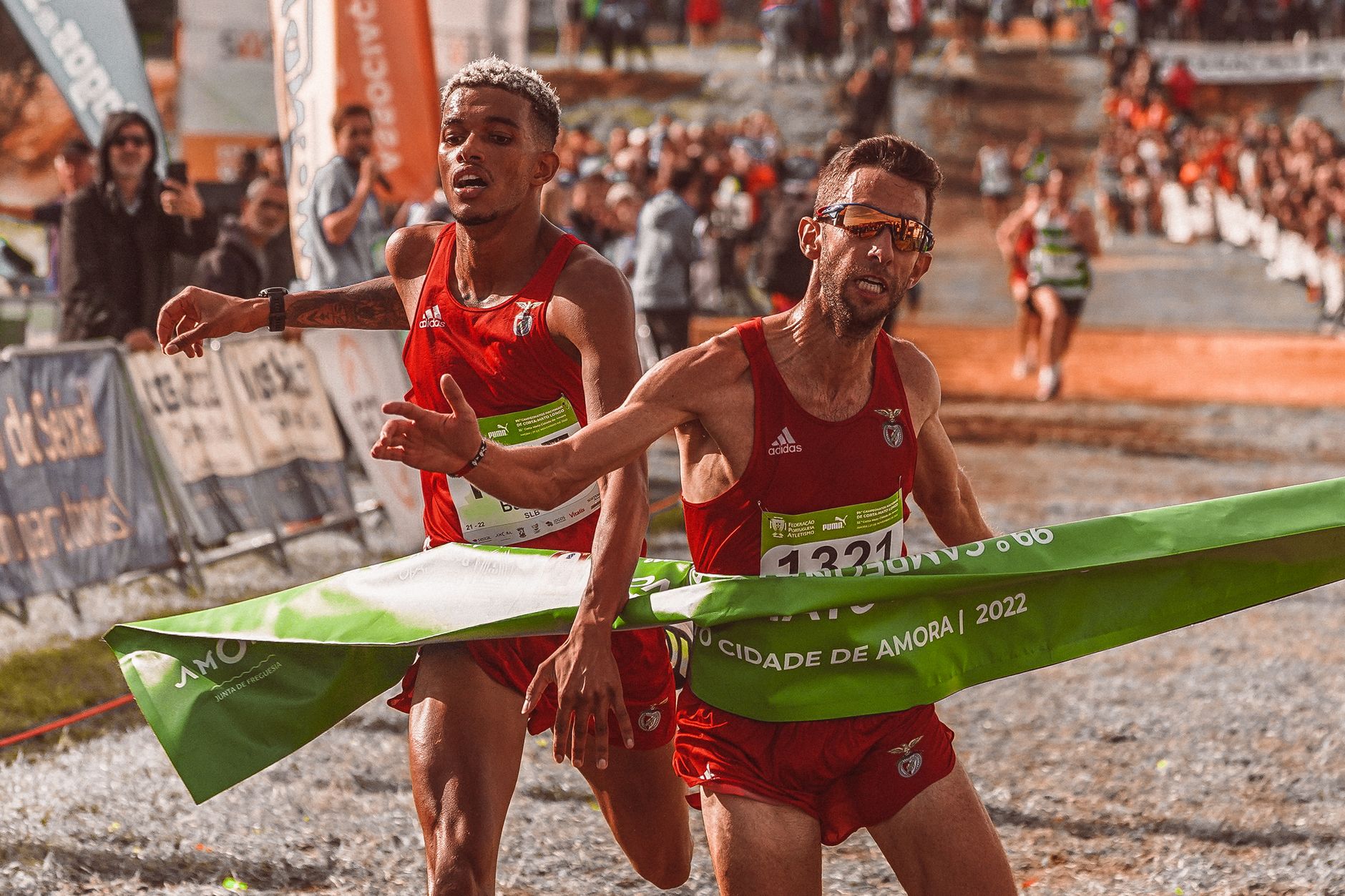 Photo by RUN 4 FFWPU on Pexels
Predicting a Race Time at a New Distance With Riegel's Formula
Runners moving up or down in distance for the first time, say from a 10K personal best to a first half marathon, often want a realistic goal pace rather than a guess. Riegel's formula does this by taking a known time at one distance and projecting an equivalent effort at another, using a fatigue exponent derived from decades of race result data. It is not perfect, since it assumes similar training and conditions, but it is dramatically more accurate than doubling a 10K pace and hoping it holds for 13.1 miles.
The formula tends to overestimate what a first-time racer at a new, longer distance can actually hold, because endurance at a new distance is its own skill that raw speed does not fully predict. Treating a Riegel-projected time as an optimistic ceiling, then building in a buffer of a few percent for a debut at the distance, produces a far more realistic goal pace than the raw formula output alone.
How Terrain, Weather, and Elevation Change Real-World Pace
A pace calculated on flat ground in ideal conditions is a starting point, not a guarantee. Every 1,000 feet of net elevation gain on a course costs the average runner somewhere in the range of 20 to 30 seconds per mile, and that cost does not fully reverse on the downhills the way runners expect. Heat matters even more: research on marathon performance shows meaningful pace slowdowns once temperatures climb past roughly 60 degrees Fahrenheit, with the effect compounding as humidity rises.
Course-specific adjustment is why the same runner can hit a personal best on one course and miss goal pace by ten minutes on another, despite identical training. Checking a course elevation profile and historical race-day weather before setting a goal pace, and adjusting the target down for hot or hilly courses, prevents a pacing plan built on a flat, cool assumption from falling apart against real conditions.
 Photo by Stephen Leonardi on Pexels
Common Pacing Mistakes That Wreck a Race in the Final Miles
The most common mistake is starting too fast because the field feels crowded and adrenaline is high, then paying for those extra seconds per mile many times over once glycogen runs low. A close second is ignoring the difference between effort and pace on hills, holding goal pace on an uphill by pushing harder rather than letting pace drop slightly and effort stay level.
A third mistake is treating the goal pace from months-old training as fixed, even when race-day fitness, weather, or course profile has clearly changed. A pace goal set during peak training in cool weather should be revised down for a hot race day; stubbornly chasing the original number usually produces a worse outcome than adjusting the plan an hour before the gun.
Using a Pace Calculator to Set Realistic Training Paces
Race pace math is not just for race day. Easy runs, tempo runs, and interval workouts are all typically prescribed as a percentage adjustment off current race pace or a recent time trial, and getting that baseline number right shapes every workout that follows. An easy run that is actually run at near-tempo effort because the baseline pace was miscalculated defeats the purpose of the easy day and accumulates fatigue that shows up later in the training block.
Runners building a structured plan, whether self-coached or following a published program, benefit from recalculating training paces every few weeks as fitness changes rather than locking in one set of numbers for an entire training cycle. A pace that felt like tempo effort in week 2 might be comfortably sustainable by week 10, and training paces that never update stop reflecting the fitness a runner has actually built.
Putting It Together: A Race-Week Pacing Checklist
Race week is not the time to introduce a new pacing strategy. Finalize the goal pace based on recent training and realistic conditions, write out mile splits (adjusted for known hills or heat), and decide in advance how the first mile will be run deliberately conservative rather than left to adrenaline. A written plan, even a simple wrist card, removes decision-making from the moments when a tired brain makes the worst calls.
For runners who want the full library of splits, unit conversions, and finish-time projections without redoing the math for every race, EvvyTools keeps a full set of fitness calculators available alongside more race-planning breakdowns on the EvvyTools blog. The goal is the same either way: replace the guessing with a plan, and let the plan do the work that adrenaline otherwise tries to take over.
Pacing well is a skill built from arithmetic, course knowledge, and a little bit of race-day discipline. None of the individual pieces are hard on their own. Put together into a written plan before the start line, they are the difference between a race that falls apart at mile 20 and one that finishes exactly how it was supposed to, back on evvytools.com or on paper taped to a water bottle.
Further reading on pacing strategy and race planning is widely available from running governing bodies and major race organizers, including USA Track & Field, the Road Runners Club of America, and the Boston Athletic Association, all of which publish pacing and training resources alongside their event calendars. Training platforms like Strava also make it straightforward to review actual mile splits from past races, which is often the fastest way to see where a previous pacing plan broke down. For background on race distance standards and history, the Wikipedia entry on the marathon is a solid starting point.