

Anyone who has wired up an LED, picked a resistor for a microcontroller pin, or sized a fuse for a battery pack has bumped into Ohm's Law. The equation is famously short: V equals I times R. There is no calculus, no complex numbers, nothing harder than middle school algebra. And yet the same hobbyists who can solve it cleanly on paper will sit on a bench with a smoking resistor and a confused look, because somewhere between the math and the wire they tripped on a unit prefix.
This guide walks through where those trips happen, how to keep the prefixes straight, and how a small calculator at your elbow can save the resistor you just paid two dollars for. It is written for the person who already understands what Ohm's Law says and is tired of double-checking whether the answer should be 10 or 10,000.
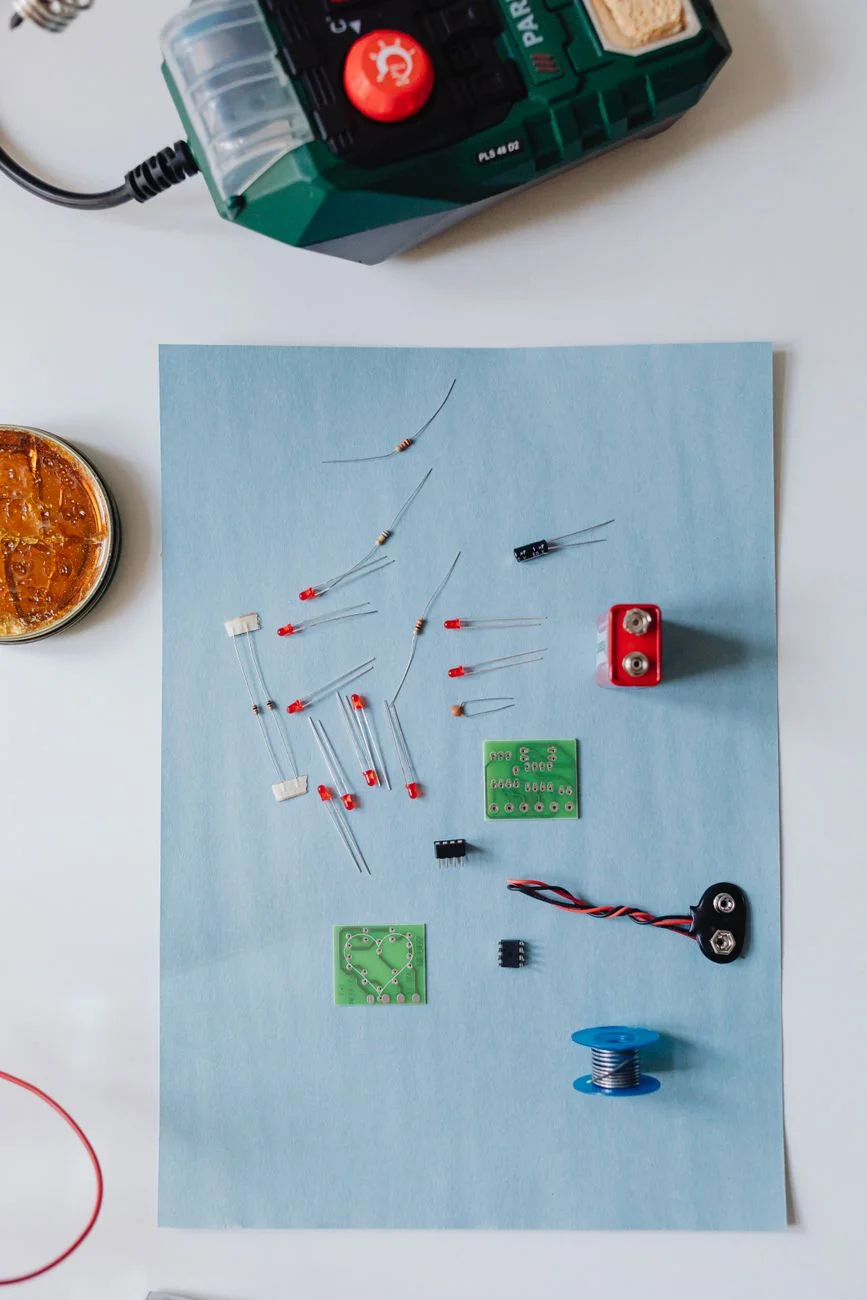
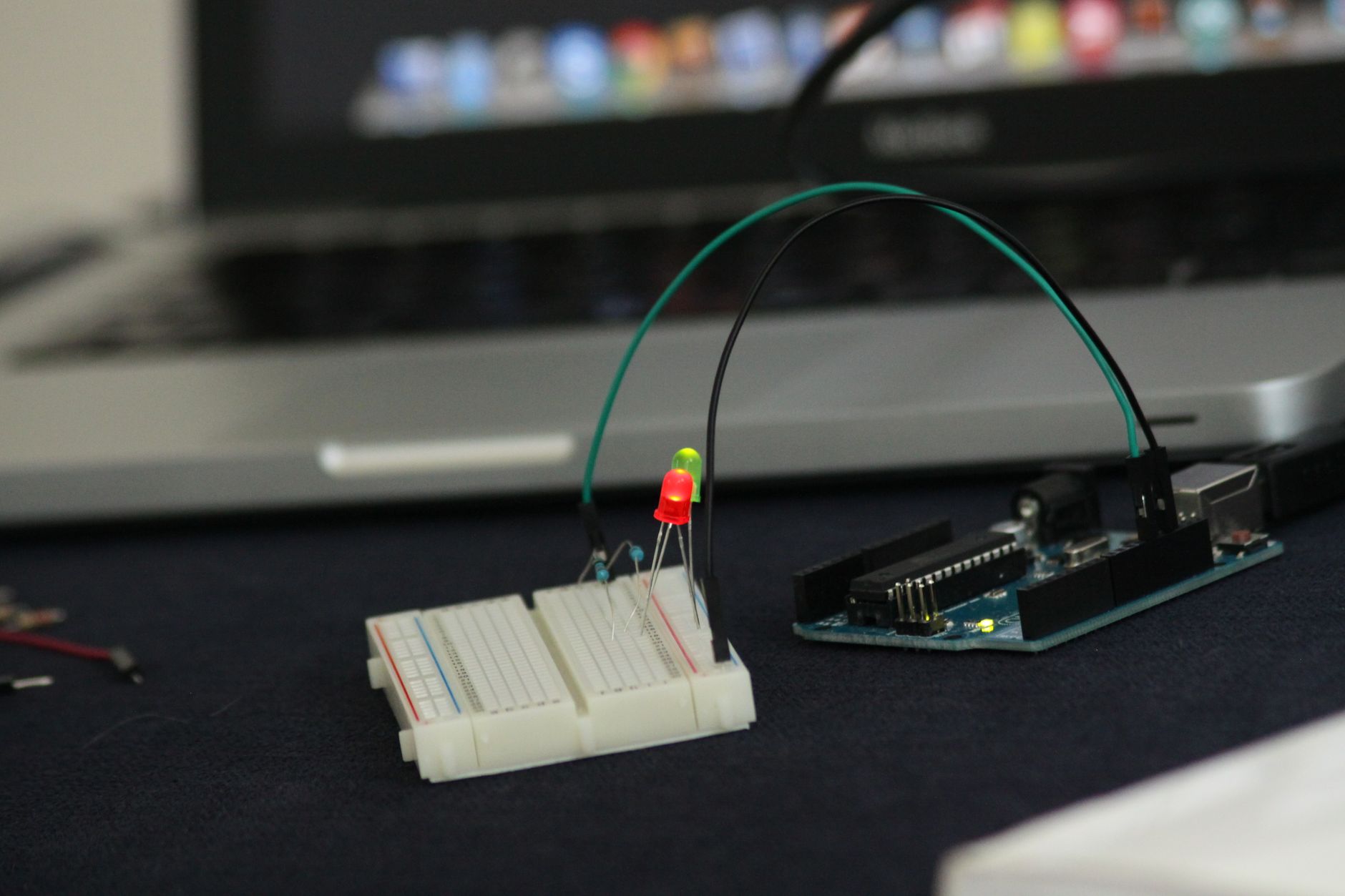 Photo by Marc Mueller on Pexels
The math is not the problem
Ohm's Law has three forms and the Power Law has four more, and that is the whole thing. Voltage equals current times resistance. Power equals voltage times current. Substituting either of the first into the second gives you power as a function of any two of the original three. Seven equations. You can put them all on a sticky note.
What trips people up is not the algebra, it is the units. The same circuit can be described in volts and amps and ohms, or millivolts and milliamps and kilohms, and the numbers that come out are dramatically different even though the physical answer is the same. The calculator on the bench, the multimeter in your hand, and the datasheet on the screen rarely agree on which prefix to use. They each pick the one that produces a tidy number for their own context, which means the human in the loop has to translate.
The result is that an engineer or hobbyist who can derive Ohm's Law from first principles will still misread "470 ohms" as "4.7k" because the resistor color band looked yellow in fluorescent light, or punch "200" into a calculator when the field expected milliamps. The wrong number drops a resistor that should have dissipated 0.05 watts into a circuit that asks for 0.5 watts, and a quarter-watt resistor gives up smoking on the bench.
The three places unit slips happen
There are three predictable places where the prefix gets dropped, swapped, or guessed at. Once you know what they are, you can write the units down explicitly the first time and avoid all three.
The first is the multimeter readout. A handheld meter on autorange shows "4.70 k ohm" with the "k" tucked off to the side of the digits. In a hurry, the eye picks up the 4.70 and stops. The reader who plugs that into a calculator as "4.7" instead of "4700" is off by three orders of magnitude. Manual-range meters have the same problem in reverse: the dial is set to 200 ohms, the digits read "00.0", the user reads "zero ohms" and concludes there is a short, when really the meter is just pegged at the bottom of an out-of-range scale.
The second is the resistor color code. A four-band resistor in red, red, red, gold reads 2.2k ohms with 5 percent tolerance. The same resistor in red, red, brown, gold reads 220 ohms. The third band is the multiplier, and squinting at red versus brown under a desk lamp is how kits with five hundred resistors turn into kits with one resistor of unknown value sitting in your hand. The Digi-Key resistor reference has a clean color decoder, and the major distributors all publish similar charts.
The third is the datasheet that mixes units. A MOSFET datasheet will quote drain-source voltage in volts, gate threshold voltage in volts, on-resistance in milliohms, and gate charge in nanocoulombs, all on the same page. Read them in the wrong order, plug one of them into a calculator without converting, and you get an answer that is three or six orders of magnitude off. The reader who notices the answer is "weird" and reaches for a calculator is fine. The reader who trusts the number and orders parts on it is going to be unhappy.
 Photo by Lisha Dunlap on Pexels
Why a calculator helps even when the math is easy
If Ohm's Law is just multiplication, why use a calculator at all? The honest answer is that the calculator is doing two things at once. It is computing the arithmetic, which is trivial, and it is enforcing a consistent unit system, which is not.
A purpose-built Ohm's Law Calculator lets you type "4.7" into a resistance field and pick "k ohms" from a dropdown, and it stores the value as 4,700 ohms internally. You then type "5" into the voltage field, leave the prefix on volts, and ask for current. The answer comes out as 0.00106 amps, or 1.06 milliamps, with the prefix the calculator thinks fits the magnitude. You did not have to convert anything to base units in your head, and you did not have to count zeros to figure out where the decimal goes in the answer.
That second job, the prefix discipline, is where the calculator pays for itself. On a fresh circuit you may switch contexts three times in a single sitting. You read 4.7k ohms off a resistor, 5 volts off a regulator, and 1.06 milliamps off the calculator. If the next step is to compute power, you have to multiply current by voltage. Doing that by hand requires converting milliamps to amps before multiplying, or carrying the milli- through the multiplication and tracking that the answer comes out in milliwatts. Either way works if you are paying attention. Skipping either step gives you an answer that is a thousand times too big or too small. The calculator just does it.
The five problems you actually solve at the bench
In practice, the bench math you do with Ohm's Law falls into five recurring shapes. Learning the prefix pitfalls for each one saves more time than any general advice about staying careful.
The first is sizing a current-limiting resistor for an LED. You have a supply voltage, a forward voltage from the LED datasheet, and a target current. You subtract the forward voltage from the supply, divide by the target current, and that is your resistor value. The trap is that the target current is in milliamps and the supply is in volts. If you skip the conversion, the answer comes out in kilo-ohms when it should be in ohms, and you put a 10k resistor in front of an LED that wanted a 470 ohm resistor, and the LED is dim or off.
The second is choosing a power rating for a resistor in a divider or pull-down. Multiply the voltage across the resistor by the current through it. The hidden trap is that the current is often expressed in microamps for high-impedance dividers, and milliwatts of power dissipation are below the rating of any standard resistor, so the answer feels like it does not matter. It does, once you start scaling the same divider for a higher voltage in a different application. Skip the math now and the same circuit fails later. The Electrical Engineering Stack Exchange archives are full of postmortems that come down to "the divider was sized for 5 volts and someone reused it at 24 volts without recomputing power."
The third is sizing a wire for current. You have an expected current, an acceptable voltage drop, and a wire run length. You look up the wire's resistance per foot or per meter, compute the total resistance, multiply by the current, and check whether the voltage drop is acceptable. The traps are the units: resistance per foot is usually in milliohms per foot for the common gauges, and the lookup table you pull off the internet is often in ohms per kilometer or ohms per thousand feet. The American Wire Gauge tables on Wikipedia and the equivalent IEC tables both make the unit clear if you read the column header. Skipping the header is how you end up with a 12 AWG wire when 18 AWG would have done.
A bench calculator is not for the math. It is for keeping the prefixes honest so you do not blow up the resistor you just paid for. - Dennis Traina, founder of 137Foundry
The fourth is computing the discharge time of a capacitor through a resistor. The time constant is resistance times capacitance, which sounds easy, until you notice that resistance is in ohms or kilohms, capacitance is in microfarads or nanofarads or picofarads, and the answer is supposed to come out in seconds. The conversion to base units before multiplying is the only safe way. The result rarely matches anyone's intuition for a circuit they have not built before, which is why the calculator helps even on a math problem that is technically only one multiplication.
The fifth is reading a battery capacity off a datasheet and computing runtime for a load. Capacity is in milliamp-hours or amp-hours, load current is in milliamps or amps, and runtime in hours is capacity divided by current. If the two values use different prefixes, the answer comes out a thousand times wrong. Battery datasheets from vendors like Panasonic usually quote mAh; system-level datasheets sometimes quote Ah. The reader has to convert before dividing, or hand the work to a calculator that enforces it.
 Photo by Alexey Demidov on Pexels
How to read a calculator output without second-guessing
The most useful habit for working with any Ohm's Law calculator is to read the prefix on the answer the same way you read the prefix on the input. The calculator does not know whether you wanted milliamps or amps. It picks the prefix that gives you a tidy number, and that prefix changes from one problem to the next.
If the answer is 0.00106 amps, the calculator might display "1.06 mA" or "1.06e-3 A" or "0.00106 A" depending on its default. You read off the digits, you read off the prefix, and you write both down. If the next step in your bench note is to plug that value back into another calculation, you carry both. The trap is the moment you carry just the digits and forget the prefix. The number 1.06 is meaningless without the unit. The number 1.06 mA tells you exactly what to do next.
Most engineers learn this the hard way the first time they sketch a calculation on a napkin and lose track of where the prefix went. After that they write everything in engineering notation with the unit attached. The calculator on the bench can enforce that habit by default. Use the dropdown, do not let it auto-collapse the prefix, and write down what the screen shows.
When to skip the calculator entirely
There are times when not using a calculator is faster and more honest. If the numbers are simple enough that you can do the math in your head, do it in your head, and check the prefix afterward. The classic example is the 1k pull-up on a 3.3-volt logic line: voltage divided by resistance is 3.3 milliamps, which fits inside the IO pin's sink current budget. You do not need a calculator for that. You need to remember that 3.3 over 1k is 3.3 mA, not 3.3 A or 3.3 microamps, and that comes from doing it in your head often enough that the prefix sticks.
The calculator pays off when the numbers are not in your head, or when you are switching contexts. The fortieth time you size a current-limiting resistor for an LED in a kit, you have the formula memorized and you can do it by hand in fifteen seconds. The first time you compute the discharge time of a 47-microfarad capacitor through a 220k resistor, the calculator at your elbow is the difference between getting it right and getting it wrong. Knowing which case you are in is part of the skill.
For most hobby and bench work, the Ohm's Law Calculator is set up to give you the prefix-handling for free, so the only thing left for you to do is the part that actually requires judgement. Use the calculator for the conversion. Use your head for the circuit.
The short version
Ohm's Law is one of the easiest pieces of math in electronics, and most of the wrong answers come from unit prefixes, not from the formula. The three predictable trap spots are the multimeter readout, the resistor color code, and the datasheet that mixes prefixes. A small calculator that lets you pick the prefix on each input and reads it back to you on each output handles the bookkeeping you would otherwise do in your head.
The five recurring bench problems are LED resistors, resistor power ratings, wire sizing, RC time constants, and battery runtime. Each one has a unit trap that is more likely to bite you than the math itself. Get the prefix discipline right and the answers come out correct without having to check them twice.
For more practical tools that handle this kind of unit bookkeeping automatically, browse the rest of the EvvyTools math and science directory or the EvvyTools blog for related guides.