

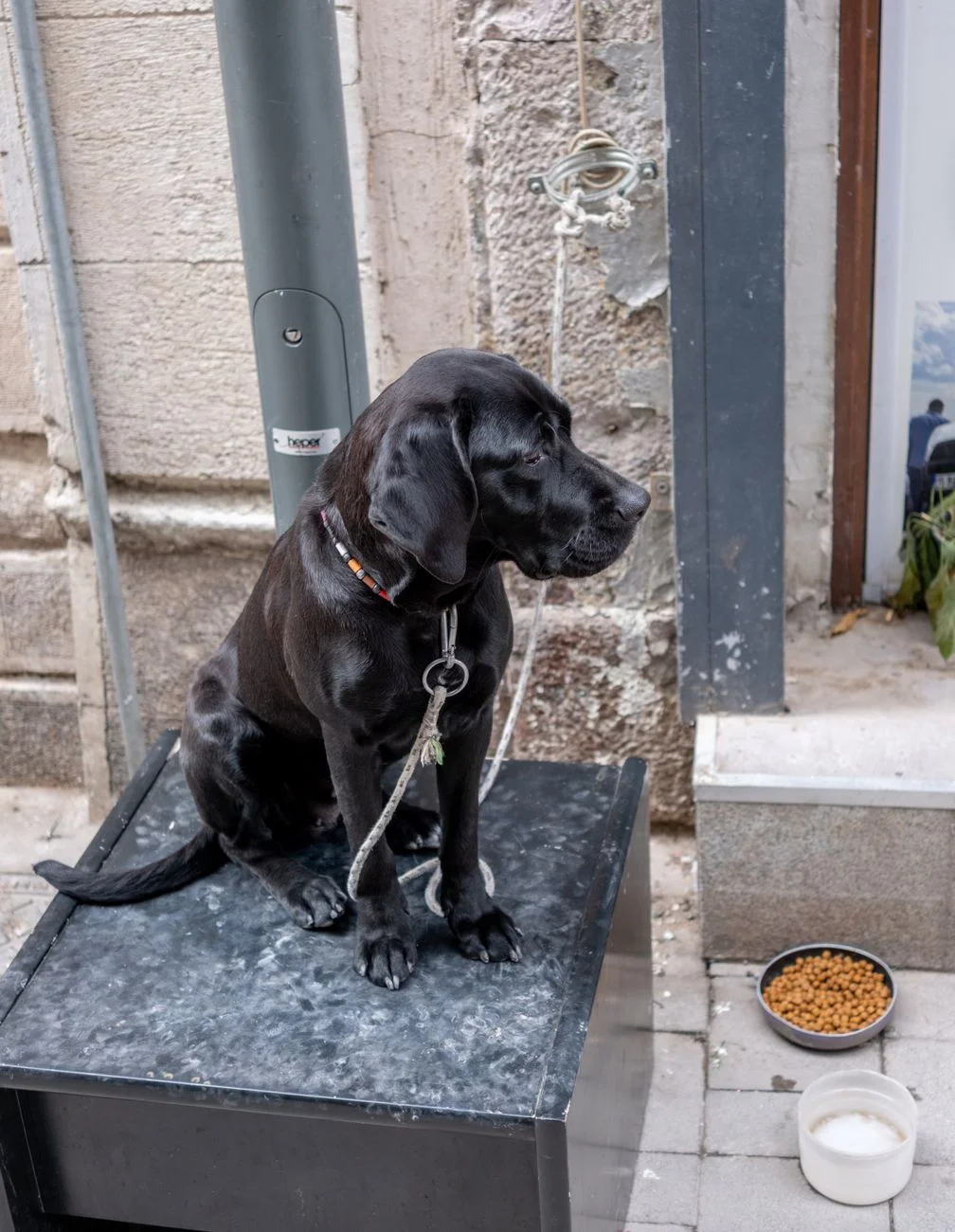
The feeding chart printed on the side of a dog food bag is the single worst place to get your dog's daily portion. It's written for a generic, moderately active adult dog that doesn't exist, and it rounds up. Vets see the result constantly: dogs sliding a pound or two over their ideal weight every year because the owner was following instructions that were designed to sell more food, not to fit their specific dog.
 Photo by Surendra Basnet on Pexels
Getting the number right isn't complicated, but it does take more than one input. Body weight alone tells you almost nothing without activity level and life stage layered on top. This guide walks through the actual formula vets use, how to adjust it for your dog's real situation, and where a free dog food calculator from EvvyTools saves you from doing the math by hand every time the bag runs low.
Why the bag's feeding chart gets it wrong
Feeding charts are built around body weight ranges and a single "average" activity assumption, usually something close to a lightly active adult dog. If your dog is a spayed, senior, mostly-couch dog, or conversely a working breed that runs for an hour a day, the chart's middle-of-the-road number is wrong in one direction or the other.
There's also a commercial incentive baked in. A chart that recommends slightly more food per day than a dog strictly needs means the bag empties faster and the owner buys another one sooner. That's not a conspiracy theory, it's just how volume-based recommendations tend to drift when nobody's checking them against actual outcomes.
The RER formula vets actually use
Veterinary nutritionists start with Resting Energy Requirement, or RER: the calories a dog burns doing nothing, just existing. The standard formula, referenced by groups like the World Small Animal Veterinary Association, is 70 multiplied by the dog's body weight in kilograms, raised to the 0.75 power. It looks intimidating written out, but it's just a curve that scales calorie needs correctly across a huge weight range, from a 4-pound Chihuahua to a 150-pound Mastiff, without accidentally over- or under-feeding the animals at the extremes.
From RER, you multiply by a factor for the dog's actual life stage and activity level to get Maintenance Energy Requirement (MER), which is the number that actually matters for a feeding decision. A typical adult, spayed or neutered dog sits around 1.6x RER. An intact adult is closer to 1.8x. A working or highly active dog can run 2x to 5x depending on the intensity and duration of the work.
From calories to grams or cups
Once you have a daily calorie target, the next step is converting that into a real serving size, and this is where most people give up and eyeball it. Every food's calorie density, listed as kcal per cup or kcal per kilogram on the bag or the manufacturer's site, is different. A dense, high-fat performance formula might pack 500 kcal per cup, while a weight-management formula might sit closer to 300.
Divide your dog's daily calorie target by the food's kcal-per-cup figure and you get the actual daily volume. This is the step a dog food calculator handles automatically once you enter your dog's weight, activity level, and the food's calorie density from the label, instead of you doing unit conversion with a phone calculator standing in the pet aisle.
How activity level changes the number
Activity level is the single biggest lever after body weight, and it's the one owners most consistently misjudge. A dog that gets two 20-minute walks a day is "lightly active," not "very active," even though it feels like a lot from the owner's chair. True high-activity multipliers are reserved for dogs doing real work: herding, hunting, agility training multiple times a week, or sled and service work.
Overestimating activity is the most common reason a feeding calculation comes out too generous. If you're not sure which bracket your dog falls into, round down. It's easier to add a bit more food after a few weeks of monitoring body condition than to walk back an inflated daily amount your dog has already gotten used to.
 Photo by Jay Brand on Pexels
Puppies, seniors, and life-stage adjustments
Puppies need considerably more calories per pound of body weight than adults because they're building tissue, not just maintaining it. The American Kennel Club notes that a large-breed puppy can need close to twice the RER multiplier of an adult dog of the same eventual size, tapering down as growth slows toward the one-year mark (later for giant breeds).
Senior dogs generally need less, not because aging itself burns fewer calories directly, but because activity typically drops and lean muscle mass declines with it. A senior-specific formula from a calculator, or simply re-running the numbers with a lower activity multiplier every six months or so, keeps the daily amount matched to what an older dog's body is actually doing rather than what it did three years ago.
Spayed and neutered dogs need a real adjustment, not a guess
Spaying and neutering measurably lowers a dog's metabolic rate, generally in the range of 20 to 30 percent compared to an intact dog of the same size and activity level. This is well documented by the American Veterinary Medical Association and it's exactly the kind of adjustment a feeding chart on a bag has no way to account for, since the chart doesn't know your dog's reproductive status.
Skipping this adjustment is one of the most common reasons a "correctly" fed dog still gains weight in the year or two after the procedure. The math still checks out on paper using the pre-surgery multiplier, it's just the wrong multiplier for the dog's new baseline.
Using the calculator for weight management
If your dog is already overweight, the goal isn't to feed for the current weight, it's to calculate calories for the target weight and feed toward that number gradually, typically aiming for a loss rate of around 1 to 2 percent of body weight per week. Feeding for current weight just maintains the status quo.
A calculator makes this painless to model: run the numbers once for current weight, then again for goal weight, and use something close to the midpoint as a starting point, adjusting every couple of weeks based on how the dog's body condition actually responds. This beats guessing at a flat 10 percent cut, which can be too aggressive for a small dog or nowhere near enough for a large one.
Reading the calorie density label correctly
Manufacturers are required by FDA pet food labeling guidance to disclose caloric content, but the format varies. Some list kcal per cup, some per kilogram, some per can for wet food. Before you can calculate a real serving size, you need this number in the same units the calculator or your own math is using, which usually means kcal per cup for dry food and kcal per can or per ounce for wet food.
If the bag doesn't list it clearly, most major manufacturers publish it on their own product pages or will provide it if you contact customer service. Don't estimate this figure. A dense performance food and a light weight-management food from the same brand can differ by 40 percent or more in calories per cup, and that difference compounds into a real over- or under-feeding problem within a few weeks.
 Photo by Barking Royalty on Pexels
Common mistakes worth double-checking
The most frequent error is treating the bag's suggested amount as gospel rather than a starting estimate meant for an average dog that isn't yours. A close second is estimating activity level generously, which we covered above. A third, less obvious one is forgetting to recalculate after a significant life change, a spay or neuter surgery, a switch to a denser or lighter food, or a jump in age into the senior bracket.
Treats matter too. The 10 percent rule, keeping treats under roughly a tenth of total daily calories, is easy to blow past with training treats or a few pieces of table food, and none of that gets automatically subtracted from the base feeding calculation unless you do it yourself.
Multi-dog households add another layer of drift. It's tempting to split one bag evenly by number of dogs rather than by each dog's individual weight and activity level, which quietly overfeeds the smaller or less active dog in the house every single day. Running the calculation separately for each dog, even when it feels like overkill for a five-pound difference, is the only way to catch that kind of steady, invisible overfeeding before it shows up as extra pounds at the next checkup.
What to do when you switch foods
Every time you change brands or formulas, run the numbers again rather than matching the old scoop size to the new bag. Two foods that look similar on the shelf can have meaningfully different calorie densities, and matching volume instead of calories is one of the fastest ways to accidentally over- or under-feed during a transition. Do the math once at the start of the switch and you avoid two or three weeks of guessing while your dog's weight quietly drifts in one direction.
Gradual transitions matter for digestion too, but that's a separate concern from the calorie math. Mixing old and new food over five to seven days prevents stomach upset; recalculating the target serving size for the new food's calorie density is what keeps the amount itself accurate once the transition is finished.
Pairing the calculator with your vet's guidance
None of this replaces an actual veterinary exam. A calculator gives you a solid, formula-based starting point grounded in the same RER math vets use, but it can't feel your dog's ribs, check body condition score using a scale like the one published by the American Animal Hospital Association, or flag an underlying condition like hypothyroidism that changes the metabolic picture entirely.
The practical approach is to use a free dog food calculator from EvvyTools to get a defensible starting number, then confirm and fine-tune it at your next regular checkup, and recheck the math anytime something material changes, weight, activity, age bracket, or food. That combination, a real formula plus a professional check-in, is what actually keeps a dog at a healthy weight over years, not just for one lucky bag of food.