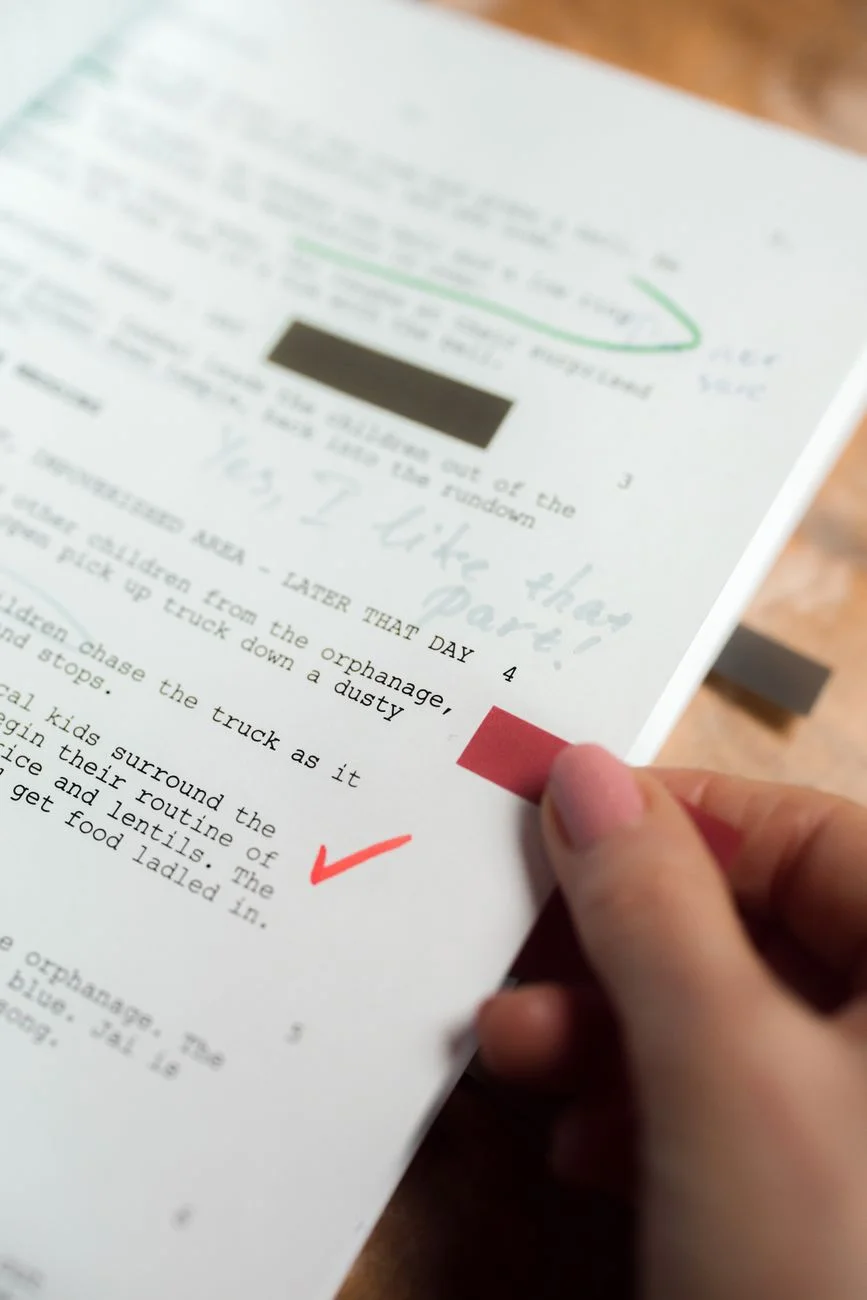


Most content briefs do not survive the draft. They get read once, set aside, and the writer falls back on the same instincts they always use. By the time the editor sees it, the article is structured around whatever felt natural to the person typing, not whatever the brief said. Then everyone spends an afternoon negotiating it back into shape.
A brief that actually survives is doing something different. It is not a wish list. It is a set of constraints on the four or five places writers are most likely to drift, written in the order the writer will encounter them. The rest can be left out, and probably should be.
This piece is about what those constraints are, why they survive, and where most briefs go quietly wrong.
 Photo by cottonbro studio on Pexels
The brief is a contract about the parts the writer cannot improvise
The fundamental issue with most briefs is that they treat every part of the article as equally important. The target keyword, the meta description, the H2 outline, the tone, the audience, the suggested sources, the CTA - all listed flat, all equally bulleted, all weighted the same in the writer's eye.
But the writer is not going to drift evenly across the article. They are going to be highly faithful in some sections (titles, headings they liked) and highly creative in others (intros, transitions, examples, the conclusion). A brief that does not know the difference is leaving the creative sections completely uncontrolled.
So the test for what belongs in a brief is not "is this important." The test is "is this a place the writer is likely to freewheel." If yes, write it down with constraint. If no, leave it implicit and trust the writer.
The four places this is almost always true:
- The intro. Writers will rewrite the angle on instinct, often within the first 200 words.
- The H2 structure. Mid-article, writers add or merge sections to fit a rhythm they like.
- The sources. Without specific links in the brief, writers either skip citations or grab the first result they find.
- The CTA. Almost always written as filler at the end because no one told the writer what action the post is supposed to produce.
If the brief constrains those four, the article comes back close to what you asked for. If it constrains anything else and skips one of those, it will not.
The intro framework - write the first 150 words of the brief
The most common failure mode is the brief that says, "Open with a hook that grabs the reader." That sentence does not constrain anything. The writer reads it, nods, and writes whatever felt clever in their head.
A surviving brief writes the intro framework explicitly, in the voice the writer should match. Not the actual intro - you do not want to write the article inside the brief - but a sketch of the structure:
- First sentence: name the reader's specific frustration in their words
- Second-third: confirm it is a real problem (one stat or named example)
- Fourth: state what this piece will give them and what it will not
- Last sentence: transition into the first H2 without recapping
That is four sentences of constraint that takes you sixty seconds to write and saves a redraft. The reason it works is that the writer has nothing to argue with. They cannot freewheel because the slots are already named.
Google's own guidance on helpful, reliable, people-first content sits underneath this - readers want the piece to deliver on the promise of the title quickly, and the intro is where that promise either lands or evaporates.
Heading hierarchy with word counts, not just titles
Most brief outlines list H2s as titles only:
- What is X
- Why X matters
- How to do X
- Mistakes to avoid
Those are not constraints. They are categories. Within a category labeled "Why X matters," the writer can produce 80 words or 800 and either looks like they hit the brief.
A surviving brief attaches a target word count to each heading. Not exact, but a range tight enough to matter:
- What is X (150-200 words)
- Why X matters (250-300 words)
- How to do X, step by step (700-900 words)
- Mistakes to avoid (250-300 words)
- Wrap and CTA (150-200 words)
Now the writer knows that "How to do X" is where the article actually lives. They do not pad the intro into a 600-word essay. They do not blow through the steps in 200 words because they ran out of energy.
Word counts on headings also force you to reckon with the article's center of gravity before drafting. If your "How to" section is short and your "Why it matters" section is long, the piece is going to read as marketing, not as a guide. You see that misallocation in the brief, before anyone has spent four hours writing.
 Photo by ROMAN ODINTSOV on Pexels
Suggested sources as actual URLs, not "credible sources"
A line in the brief that says "Cite credible sources where appropriate" is a guarantee the writer will either skip citations or grab whatever Google returns for the topic. Neither is what you want.
A surviving brief lists the specific sources by URL, with one line each on why that source is in the brief:
- Wikipedia entry on content marketing for definitional grounding in the intro
- Schema.org Article type when the H2 on structured data comes up
- Content Marketing Institute for the industry stat in section 2
Three things happen when the brief does this. The writer stops avoiding citations because they no longer have to find them. The sources stay consistent across articles in the same content series, which builds topical authority. And the editor knows what to fact-check.
The brief does not need to source every claim. It needs to source the load-bearing claims - the ones the article's argument depends on. If a writer adds a citation later, fine. If they would have had to invent one, the brief has already supplied it.
The CTA the brief should write itself
Almost every brief I have seen ends with something like "Wrap with a call to action driving to [tool / service / signup]." Then the writer types two sentences of filler at the end of the article and everyone calls it done.
A surviving brief writes the CTA as a complete paragraph in the brief itself. Not because the writer cannot do it - they can - but because the CTA is the part most likely to be skipped or watered down on a tight deadline, and the part most likely to mismatch the funnel stage if left to instinct.
Specify three things:
- What the reader is supposed to do (try the tool, read another guide, subscribe)
- What objection the CTA needs to address (cost, time, signup friction)
- What anchor text wraps the link
If the brief reads "Drive to our free content brief builder by EvvyTools as a way to apply what they just read without writing one from scratch," the writer pastes that sentence in and moves on. If the brief is vague, the writer guesses. The guess is rarely good.
A brief is also a no-list
Most briefs only specify what to include. A surviving brief specifies what to leave out, especially around overlap with the rest of the site.
If you have a separate landing page that targets "content brief template," the post-level brief should explicitly say: do not use "content brief template" in the H1 or meta title; do not structure the post as a downloadable template; link to the template page once, in the conclusion. Without that constraint, the writer will optimize the post for the easiest keyword they can think of, which is often the one your landing page already owns.
The same principle applies inside a category. If three posts in a row are about "writing better intros," post four should not have intros in the title. The brief enforces that. Otherwise the writer reaches for the angle that feels fresh to them - which is often the one you have published three times already.
Briefs that survive the draft are doing the same job a good API spec does: they constrain the parts of the system that are most likely to drift, and they trust the parts that are not. The temptation to over-specify everything is also the reason most briefs get ignored. - Dennis Traina, founder of 137Foundry
What a working brief looks like end to end
If you put all of the above together, a brief for a single 1,800-word blog post comes out to roughly one page of constraints and one page of context. The constraints page is the contract: intro framework, headings with word counts, source URLs, CTA paragraph, no-list. The context page is the audience, tone, internal links, target keyword, meta description, and any compliance notes.
The constraints page is what the writer reads while drafting. The context page is what the editor reads while reviewing. Two audiences, two documents, one brief.
Most editorial teams already have the context page - they sometimes call it a "style guide" or "audience profile." The constraints page is the one that goes missing, and its absence is why drafts drift.
 Photo by N G on Pexels
When the brief is itself the bottleneck
The honest counterargument is that writing a constraints page well takes time. For a content team running ten posts a week, writing five paragraphs of brief plus an outline plus source URLs per article does not scale unless someone is paid to do nothing else.
This is where structured brief tooling starts to pay back. Templating the intro framework so it adjusts per content type, pulling source URL suggestions from a curated bank rather than a fresh search, and codifying CTA paragraphs by funnel stage all turn the writer-style "blank brief" into a series of small decisions. You can find a free content brief builder by EvvyTools that does exactly this - it ships an intro framework, H2 outline with word counts, source suggestions, and CTA recommendations as a single brief, then lets you edit before exporting.
The point is not the specific tool. The point is that "write a constrained brief" cannot stay a manual chore on a team producing more than a couple of articles a month. Either the brief gets structured or the briefs go back to being one-paragraph wish lists and the drafts go back to drifting.
You can browse other SEO and writing tools along the same lines, or read more on related editorial workflow topics on the EvvyTools blog when you have a moment.
The shape of a brief that holds
A brief that survives the draft is not a longer brief. It is a brief that knows where writers drift and pins those spots down, and that trusts everything else to good editorial instincts and a competent writer. The four pins are the intro framework, the headings with word counts, the sources as URLs, and the CTA as a written paragraph. The no-list is the fifth, and the most underused.
Skip those, and the brief is read once and ignored. Include them, and the draft comes back close enough that the edit is a polish, not a rebuild. That is the difference between a brief that holds and one that does not.