How to Scale a Recipe Up or Down the Right Way
A four-person stew that you double for eight guests rarely tastes twice as good. Halving a brownie recipe because you only want a small tray often produces something closer to a wet sponge than a chewy square. This is not because the math is hard, it is because most published recipes were developed and tested at one specific size, and many of the ingredients inside them do not behave linearly when you change that size.
Home cooks scale recipes all the time, sometimes to feed a bigger group, sometimes to cut leftovers, sometimes to fit the only pan they own, sometimes because half the ingredients in the pantry happen to be what is left. The problem is that every recipe is a tiny system of chemistry, heat transfer, and evaporation, and only the simplest of them survive a naive "multiply everything by 2." This guide walks through how to scale any recipe up or down without ruining the ratios, which ingredients need special care, how to choose the right scale factor in the first place, and how to check your result before you commit your oven time and your grocery budget to it.
Why Scaling Is Not Just Multiplication
The base assumption most people make is that a recipe is a list of independent ingredients. It is not. A recipe is a ratio sheet, where flour anchors the liquids, salt anchors the flavor, leaveners anchor the rise, and cooking time anchors the internal temperature. Change the quantity of any one thing by too much and you push the others outside their working range. That working range is narrower than it looks on paper, especially for anything baked, fermented, or emulsified, and the first sign that you have left it is usually a final product that looks right but tastes or feels wrong.

A helpful mental model comes from the baking world: baker's percentages, where flour is always 100 percent and every other ingredient is expressed as a percentage of the flour weight. A bread with 65 percent hydration will behave the same whether you mix 500 grams of flour or 5 kilograms of flour, because the ratios stay fixed. That same logic can be applied outside of bread. If you think of a recipe as a handful of core ratios instead of a list of volumes, scaling becomes a matter of keeping those ratios intact.
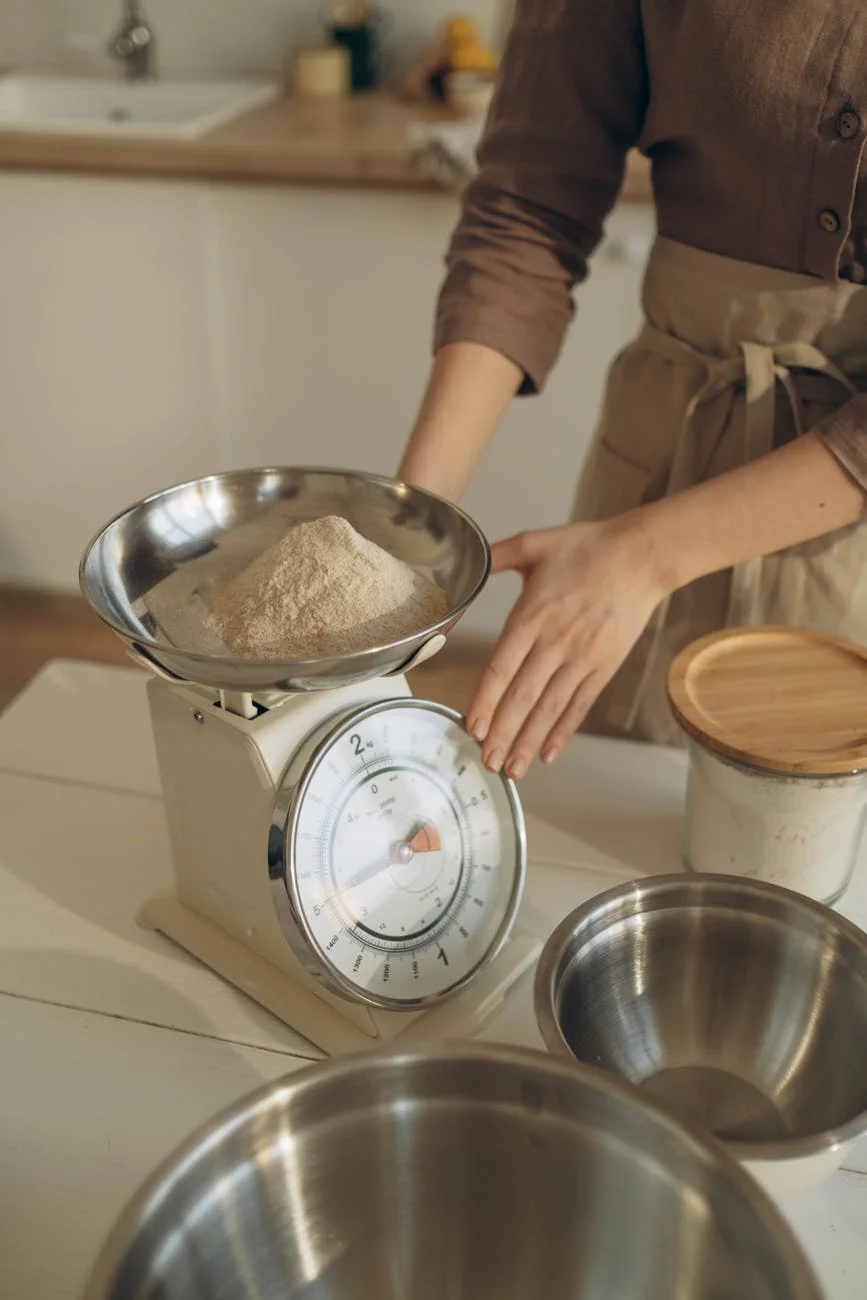
Food scientists and recipe testers at Serious Eats have written extensively about why volume measurements (cups, tablespoons) make scaling harder than weight measurements. A cup of flour can vary by 20 to 30 percent depending on whether it is scooped, spooned, or sifted, and that error compounds every time you multiply. Scaling by weight in grams removes that variable entirely and is worth the five minutes it takes to convert a recipe before you change its size.
How to Scale by Ratios Instead of Spoonfuls
The cleanest way to scale any recipe is to pick a scale factor, convert every ingredient to weight, then multiply. For a recipe that serves four people that you want to serve six, the scale factor is 1.5. For a batch of twelve cookies you want to cut to eight, the scale factor is 0.67. Apply the factor to the weights, not the volumes, and write out the new list before you touch a single ingredient.

This is the step where a free recipe scaling calculator saves you from arithmetic mistakes, especially when you are scaling by awkward factors like 1.75 or 0.4. You enter the original ingredient list, your target scale factor or target servings, and the tool returns the adjusted quantities. If you are converting between metric and imperial at the same time, it handles that too. The point of using a tool here is not laziness, it is that a single transposed digit in your head (reading 240 grams of flour as 420) can waste an entire batch and hour of your evening.
Once you have the scaled list, stop and eyeball it. Are the numbers plausible? A scaled-down pancake recipe that says "1/8 teaspoon baking powder" is probably fine, but one that says "0.03 teaspoon vanilla" is a signal that you picked too small a scale factor and you should round up to something measurable. The US Department of Agriculture's nutrient database is useful here for checking that the totals still look reasonable, because if the scaled recipe looks nothing like the nutritional profile of the original, something slipped.
The same ratio logic applies in reverse for meal prep. If you cook once and eat five times, you are really scaling a single-serving recipe up by five, and you have to pay attention to how the food holds together after storage. Dense stews, grain bowls, and braised meats usually scale up cleanly. Delicate pastas, fried foods, and anything with crispy textures do not, because the surface area to volume ratio changes once you are cooking a bigger batch in a bigger vessel, and that ratio is what controls browning, crisping, and moisture loss in every direction.
The Ingredients That Never Scale Linearly

Some ingredients look like they are part of the list but are actually part of the process, and those are the ones that break when you multiply them. Knowing which ones to handle separately is the difference between a scaled recipe that works and one that fails.
Salt, spices, and aromatics do not scale in a straight line past a certain point. Doubling a stew recipe does not mean doubling the pepper. Chef and food writer samin nosrat's work on salt explains why: salt is a flavor amplifier, not a dose-dependent ingredient, and the perception of saltiness flattens as volumes grow. A good rule is to scale salt and strong spices by about 1.5x when you double a recipe, then taste and adjust from there.
Leaveners (baking powder, baking soda, yeast) also scale nonlinearly, especially going down. Half a teaspoon of baking powder in a small cake can be too much, because the chemical reaction is proportional to surface area as well as volume, and a scaled-down pan is not half the shape of the original. If you use a baking substitution guide to help with ingredient swaps, pay close attention to the notes on leavener ratios for smaller batches.
Cooking time and temperature are the most dangerous variables to ignore. A doubled casserole does not cook in double the time, it cooks in roughly the same time if the depth of the pan stays the same, or significantly longer if it gets deeper. The FDA's cooking temperature guidelines are by internal temperature, not time, and this is the safest way to judge doneness when you are working with a scaled recipe. Use a thermometer, not a timer.
Pan size and geometry matter more than people realize. Scaling a recipe by 1.5 but keeping the same pan can mean your batter is now 50 percent deeper, which changes how heat penetrates the center. If you cannot match the pan geometry, you have to accept a longer bake time and a lower temperature, or split the batter across two smaller pans. The usual rule of thumb for dense batters like brownies and loaf cakes is to drop the oven temperature by 25 degrees Fahrenheit and add 10 to 15 minutes of cook time when the pan depth has gone up meaningfully, then check doneness by internal temperature rather than by the clock.
Related Tools and Further Reading

Recipe scaling rarely stops at one ingredient list. Once you start cooking for different group sizes, you end up adjusting unit measurements, substituting ingredients, and recalculating nutrition every time the math changes. The cooking unit converter handles the teaspoon-to-milliliter and cup-to-gram conversions that show up constantly when you scale between imperial and metric recipes. If your scaled recipe suddenly calls for an ingredient you do not have in the pantry, the baking substitution finder suggests working swaps with notes on how the texture and flavor will change. And when you scale up for meal prep or scale down for portion control, the recipe nutrition calculator recomputes calories and macros for your new serving size without you doing it by hand.
For deeper reading on the science behind scaling, Harold McGee's On Food and Cooking remains the single best reference on why ingredients behave the way they do when quantities change. America's Test Kitchen has also published extensive testing on pan-size adjustments and scaled baking recipes, which is worth reading before you attempt a heavily scaled dessert.
The Short Version
Scaling a recipe is a ratio problem, not a multiplication problem. Convert your ingredients to weight, pick a clean scale factor that leaves you with measurable quantities, run the math with a free recipe scaling calculator, and then sanity check the result before you turn on the stove. Treat salt, leaveners, spices, and cooking times as separate decisions rather than linear ingredients, and try to match your pan geometry to the original recipe whenever you can. When you cannot, drop the temperature a little, extend the time, and watch the internal temperature instead of the clock. Do all of that, and a doubled stew will taste like a doubled stew, a halved brownie will still be a brownie, a scaled bread will still rise, and you will stop throwing away batches because the math looked right on paper and wrong on the plate.