Unit conversion shows up in everyday life more often than most people expect. A recipe from a European site calls for grams but your kitchen scale reads ounces. A road trip distance listed in kilometers when you only think in miles. A hard drive advertised as one terabyte that shows up as something smaller in your operating system. These are not edge cases; they are routine. The good news is that the math behind every conversion follows the same pattern, and once you understand it, any conversion is straightforward.
This guide covers the major unit categories, the formulas that apply to each, and the one mistake that causes most real-world errors. It uses plain numbers rather than memorized rules.
The Two Major Systems of Measurement
Most countries use the International System of Units, known as SI or the metric system. Length is measured in meters, mass in kilograms, and volume in liters. Every unit scales by powers of 10: a kilometer is exactly 1,000 meters, a milligram is 0.001 grams. This internal consistency is why scientists and most governments prefer it.
The imperial system is still in common daily use in the United States. It does not have a consistent scale. Twelve inches to a foot, three feet to a yard, 5,280 feet to a mile. Sixteen ounces to a pound. Eight pints to a gallon. These ratios are historical artifacts, not a design choice.
Global measurement standards for SI are maintained by the International Bureau of Weights and Measures (BIPM), and the US equivalent is the National Institute of Standards and Technology (NIST). Both publish exact conversion values for any unit pair you might need.
Most conversion errors start with the same root cause: not knowing which system you are working in, or mixing the two during a calculation.
How Unit Conversion Works
Every unit conversion is a multiplication. You take your original quantity and multiply it by a ratio that equals exactly one. This ratio, called a conversion factor, is arranged so the unit you are converting from cancels out, leaving only the unit you want.
Example: 1 inch = 2.54 centimeters. To convert 12 inches to centimeters, multiply by 2.54:
12 inches x 2.54 = 30.48 centimeters
For compound units like speed, you apply one factor per unit component:
60 miles/hour x (1.609 km / 1 mile) = 96.54 km/hour
The "miles" unit cancels, leaving km/hour. This method is called dimensional analysis. When you are unsure whether to multiply or divide, write the fraction so the unit you want to eliminate appears on the bottom. The math handles the rest.
For routine conversions, this free online converter handles length, weight, temperature, volume, speed, data storage, area, and time without requiring you to look up factors or set up fractions by hand.
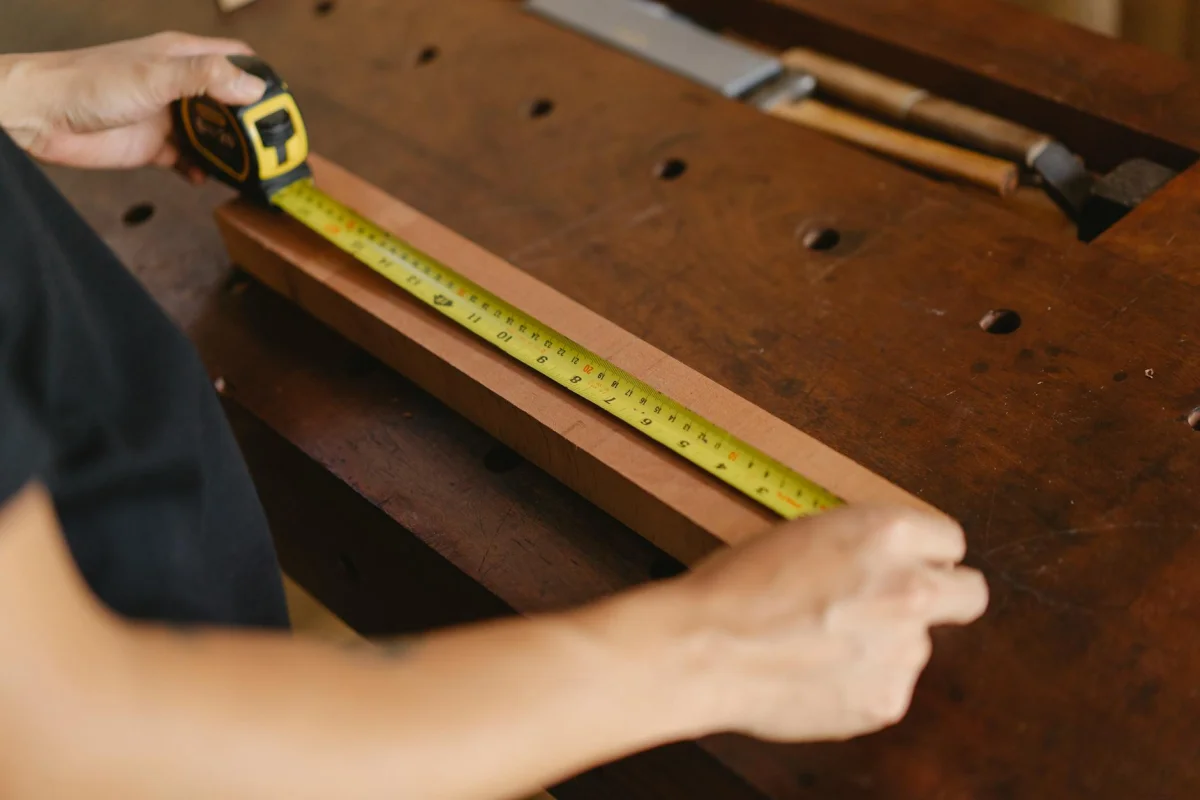
 Photo by Ahmet Çiftçi on Pexels
Converting Length and Distance
The ratios you will actually use:
Within metric: - 1 kilometer = 1,000 meters - 1 meter = 100 centimeters = 1,000 millimeters
Within imperial: - 1 foot = 12 inches - 1 yard = 3 feet - 1 mile = 5,280 feet
Cross-system: - 1 inch = 2.54 cm (exact) - 1 meter = 3.281 feet (approximately) - 1 mile = 1.609 kilometers (approximately) - 1 kilometer = 0.621 miles (approximately)
Quick mental check: a kilometer is about 60% of a mile; a meter is about 10% longer than a yard. Knowing these rough ratios gives you a sanity check before committing to a calculation. When someone quotes a distance in a foreign country, you can estimate quickly even if you do not have the precise conversion handy.
Converting Speed and Time
Speed conversions are common when driving abroad or comparing international data. The essential cross-system factor: 1 mile per hour = 1.609 km/h. To go the other direction, 1 km/h = 0.621 mph.
A practical shortcut: to convert mph to km/h, multiply by 1.6. To go from km/h to mph, divide by 1.6. A 100 km/h highway speed limit is about 62 mph; a 65 mph speed limit is about 105 km/h.
For time, the metric system applies the same prefix logic: 1 hour = 60 minutes = 3,600 seconds = 3,600,000 milliseconds. These ratios come up frequently in software engineering contexts where timestamps and latency measurements use mixed units.
Converting Weight and Mass
The imperial system introduces a persistent source of confusion: two different types of ounce. Fluid ounces measure volume; weight ounces measure mass. They are not interchangeable, and mixing them up is a reliable way to ruin a recipe or miscalculate a shipment.
For weight (not volume): - 1 pound = 16 ounces - 1 kilogram = 2.205 pounds (approximately) - 1 ounce (weight) = 28.35 grams
Medical and pharmaceutical dosing specifies milligrams (mg) or micrograms (mcg). One gram equals 1,000 mg; one milligram equals 1,000 mcg. These are not interchangeable. A 500 mcg dose is very different from 500 mg. In any clinical context, verify the unit and the conversion factor before using a computed value.
 Photo by
 Converting Temperature
Temperature is the one common conversion that requires both multiplication and addition, not just multiplication alone.
- Celsius to Fahrenheit: F = (C x 1.8) + 32
- Fahrenheit to Celsius: C = (F - 32) / 1.8
- Celsius to Kelvin: K = C + 273.15
Practical reference points: water freezes at 0C (32F) and boils at 100C (212F). A comfortable room sits at roughly 20-22C (68-72F). Oven temperatures in Celsius are approximately half what they would be in Fahrenheit, so 180C equals about 356F, typically listed in US recipes as 350F.
Kelvin is mainly used in physics and chemistry. It starts at absolute zero (-273.15C) with no negative values. For everyday conversions, Celsius and Fahrenheit cover everything you need.
Converting Volume
US cooking volume does not follow a predictable scale: - 3 teaspoons = 1 tablespoon - 16 tablespoons = 1 cup - 2 cups = 1 pint - 2 pints = 1 quart - 4 quarts = 1 gallon
Metric volume is more consistent: - 1 liter = 1,000 milliliters - 1 milliliter = 1 cubic centimeter
Cross-system conversions: - 1 fluid ounce = approximately 29.57 mL (rounded to 30 mL in practice) - 1 cup = approximately 237 mL (rounded to 240 mL for cooking) - 1 gallon = 3.785 liters
If you are adapting a recipe that uses metric weights for dry ingredients, measure by weight rather than volume. A cup of flour can vary by 10-20% depending on how it is scooped, but a gram is always a gram.
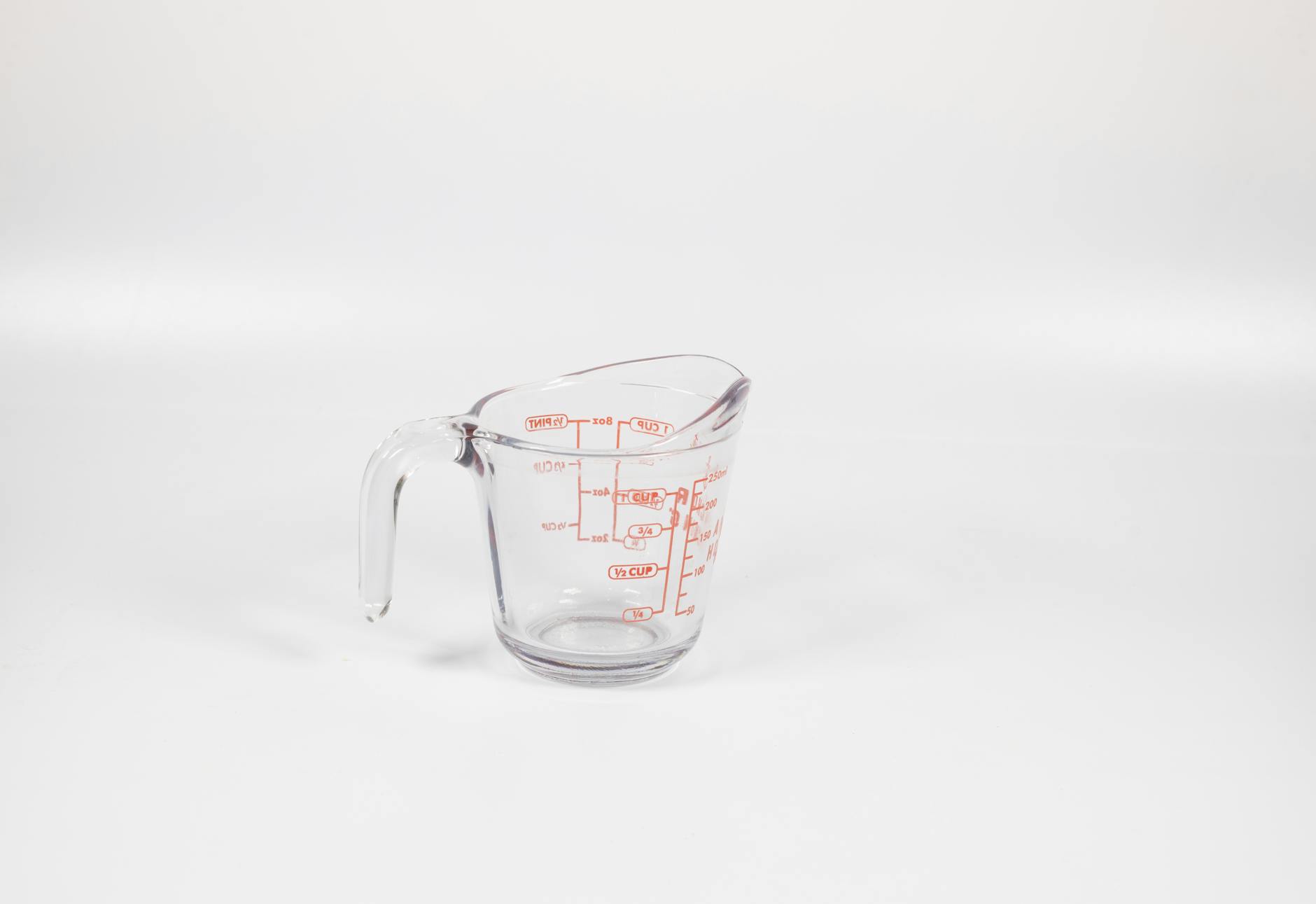 Photo by Chris Flaten on Pexels
Converting Digital Storage Units
Data storage is mostly base-10, though the exact definition depends on context: - 8 bits = 1 byte - 1 kilobyte (KB) = 1,000 bytes (used by drive manufacturers) - 1 megabyte (MB) = 1,000 KB - 1 gigabyte (GB) = 1,000 MB - 1 terabyte (TB) = 1,000 GB
Operating systems typically report storage using a base-2 system where 1 KB = 1,024 bytes. This mismatch explains why a drive labeled "1 TB" reports as approximately 931 GB in Windows. The drive and the OS are counting the same bytes; they just divide differently. For estimating storage needs or file sizes in everyday use, base-10 figures are close enough.
 Photo by panumas nikhomkhai on Pexels
The Squared and Cubed Mistake
This is the most common error in unit conversion, particularly in construction and home improvement work. If 1 meter equals 3.281 feet, you cannot convert 1 square meter to 3.281 square feet. You need to square the factor:
1 m2 = 3.281 x 3.281 = 10.76 ft2
For cubic units, cube it:
1 m3 = 3.281 x 3.281 x 3.281 = 35.31 ft3
Skipping this step produces a number that is off by a factor of 3 to 35 depending on the unit. In flooring, paint coverage estimates, or material quantity calculations, the error is large enough to significantly over- or under-order supplies. Always square the conversion factor for area and cube it for volume.
Mental Estimates vs. Exact Calculations
Quick mental approximations are useful for catching obvious errors before they cost you anything. A kilometer is roughly 60% of a mile. A kilogram is roughly 2.2 pounds. A liter is slightly more than a quart. If your calculated result is wildly off from the rough estimate, you made a mistake somewhere.
For anything that needs to be precise, including construction specs, ingredient scaling for large batches, and international shipping requirements, use a dedicated calculator. The tools directory at EvvyTools includes a unit converter alongside other everyday calculators. The EvvyTools blog pairs these tools with practical context for common scenarios.
A Five-Step Process for Any Conversion
When working through a conversion manually:
- Write down the quantity and its current unit.
- Write down the target unit.
- Find the conversion factor (or use a calculator).
- Multiply by the factor, squaring or cubing it for area and volume.
- Check that the unit in your result is the one you wanted.
Temperature is the exception: step 4 requires applying a formula with both multiplication and addition rather than simple multiplication.
This process handles any conversion from length to digital storage. The specific numbers change across categories; the structure stays the same. For conversions you do regularly, keeping a reliable reference bookmarked saves you the setup time each time. EvvyTools puts a unit converter and related everyday calculators in one place so you are not searching for the right tool each time a conversion comes up.