Every runner who has blown up in the second half of a race made the same mistake: they went out at a pace their fitness could not sustain. It feels great at mile 3 when you are 30 seconds ahead of target pace. It feels terrible at mile 10 when your legs are gone and every remaining mile takes 45 seconds longer than planned.
Pacing is the difference between a race you are proud of and a race you survive. It starts with knowing your numbers: what pace you can hold for a given distance, what your realistic finish time is based on recent training, and how to distribute your effort across the full distance so you finish strong instead of falling apart.
This guide covers pace fundamentals, explains race time prediction, walks through building a pacing strategy for any distance from 5K to marathon, and flags the mistakes that turn good fitness into bad race results.
 Photo by MART PRODUCTION on Pexels
Understanding Pace: The Numbers Behind Your Speed
Pace is expressed as minutes per mile (or minutes per kilometer). A 9:00/mile pace means each mile takes nine minutes. Over a 5K (3.1 miles), that produces a finish time of about 27:54. Over a half marathon (13.1 miles), that same pace gives you 1:57:54.
Here is a reference table showing common paces and their projected finish times across standard race distances:
Pace per mile | 5K | 10K | Half Marathon | Marathon - 7:00/mi | 21:44 | 43:28 | 1:31:47 | 3:03:33 - 8:00/mi | 24:51 | 49:41 | 1:44:53 | 3:29:46 - 9:00/mi | 27:57 | 55:55 | 1:57:59 | 3:55:58 - 10:00/mi | 31:04 | 1:02:08 | 2:11:06 | 4:22:11 - 11:00/mi | 34:10 | 1:08:21 | 2:24:12 | 4:48:24 - 12:00/mi | 37:17 | 1:14:34 | 2:37:18 | 5:14:36
Most recreational runners fall between 9:00 and 12:00 per mile. Competitive age-group runners typically run 7:00 to 9:00. Elite runners are under 5:00 per mile for distances up to the marathon.
Pace vs Speed
Pace (minutes per mile) is the inverse of speed (miles per hour). A 10:00/mile pace equals 6.0 mph. A 7:30/mile pace equals 8.0 mph. Runners use pace because it maps directly to race planning: if your goal is a 2-hour half marathon, you need to average 9:09 per mile. That number is immediately actionable in a way that "6.56 mph" is not.
Metric Conversion
To convert between miles and kilometers: 1 mile = 1.609 km. A 9:00/mile pace equals roughly 5:35/km. Most GPS watches can display either unit. According to Runner's World, training in your preferred unit and converting only for race-specific planning reduces mental overhead.
 Photo by BOOM 💥 Photography on Pexels
Predicting Race Times from Training Data
If you recently ran a 5K in 25 minutes, what half marathon time can you expect? Race prediction formulas estimate this using the principle that as distance increases, sustainable pace decreases in a predictable way.
Riegel's Formula
The most widely used prediction model, published by Peter Riegel in 1977 and still accurate for most recreational runners:
Predicted time = known time x (target distance / known distance) ^ 1.06
Using a 25:00 5K to predict a half marathon: 25 x (13.1 / 3.1) ^ 1.06 = 25 x 4.56 = 113.9 minutes, or roughly 1:54:00
This prediction assumes comparable training for both distances. A runner who trained specifically for 5K speed but has never run more than 6 miles will likely run slower than the prediction. Conversely, a runner with a strong endurance base might beat the prediction at longer distances.
Accuracy Limitations
Predictions are most accurate when the known distance is close to the target distance. Predicting a 10K from a 5K is fairly reliable. Predicting a marathon from a 5K is much less so because marathon performance depends heavily on fueling strategy, heat management, and long-run training that 5K fitness does not capture.
The Jack Daniels Running Formula uses VDOT values (a measure of running fitness) to predict race times and set training paces. It is considered more accurate than Riegel's formula for serious runners because it accounts for the non-linear relationship between VO2max and performance across distances.
Building Your Race Day Pacing Strategy
This free pace tool calculates your target pace from any two of three inputs (distance, time, pace) and generates mile-by-mile split times for your race. Enter your goal finish time and distance, and it produces a split table showing what your watch should read at each mile marker.
But having a split table is only half the strategy. How you distribute your effort across the race determines whether you hit those splits or not.
Even Splits
Running the same pace for every mile. This is the simplest strategy and works well for 5K and 10K distances where the race is short enough that fatigue does not cause dramatic pace decay. Most world records at shorter distances are run with remarkably even splits.
Negative Splits
Running the second half faster than the first. This is the gold standard for half marathons and marathons. Start 10 to 15 seconds per mile slower than your target pace for the first third of the race. Run at target pace for the middle third. Run 5 to 10 seconds per mile faster than target for the final third.
Negative splitting works because it prevents early glycogen depletion and keeps your heart rate in a sustainable zone during the critical first miles. According to analysis published in the Journal of Sports Sciences, the majority of personal bests at the marathon distance are run with negative or even splits, not positive splits.
Heart Rate Pacing
Instead of targeting a specific pace per mile, you target a heart rate zone and let pace fluctuate. This accounts for hills, wind, and temperature. A common approach: keep heart rate at 75-80% of max for the first half of the race and allow it to climb to 85-90% in the second half.
Heart rate pacing requires a chest strap or wrist-based optical sensor. The American College of Sports Medicine recommends calibrating your zones with a field test rather than using the generic "220 minus age" formula, which can be off by 10-15 beats per minute.
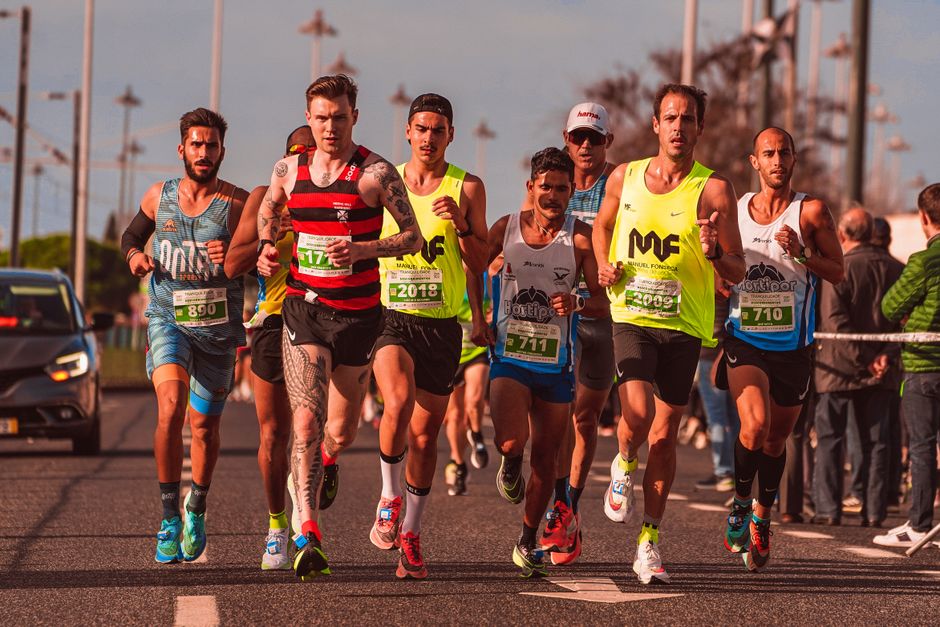 Photo by RUN 4 FFWPU on Pexels
Pacing Mistakes That Ruin Race Day
Going Out Too Fast
The most common mistake in every race distance. Adrenaline, the crowd, and the downhill start conspire to push you 20 to 30 seconds per mile faster than planned. You feel great. By mile 8 of a half marathon, you are paying for it. The rule: if the first mile feels easy, you are on pace. If it feels fast, you are going too fast.
Ignoring Elevation Changes
A flat 9:00/mile pace and a hilly 9:00/mile pace feel completely different. Uphill miles should be 15 to 30 seconds slower. Downhill miles should be 10 to 15 seconds faster. The goal is even effort, not even pace. Forcing pace on hills burns glycogen faster and leads to bonking later in the race.
Not Practicing Race Pace in Training
Your body needs to know what race pace feels like. Tempo runs (20 to 40 minutes at approximately half marathon pace) and race-specific intervals (mile repeats at goal pace with short recovery) teach your neuromuscular system what the target effort feels like. If race day is the first time your legs see that pace for that duration, they will not cooperate after halfway.
Skipping Fueling at Longer Distances
For races over 90 minutes (most half marathons and all marathons), mid-race fueling is essential. Taking a gel or sports drink every 30 to 45 minutes replaces depleted glycogen and delays bonking. Skipping fueling because "I feel fine" at mile 8 catches up with you at mile 11 when your glycogen tank hits empty.
Racing Unfamiliar Distances
Your first half marathon should not have a time goal. Your first marathon definitely should not. Racing an unfamiliar distance without having completed the distance in training (or close to it) introduces too many unknowns. The first time, just finish. Set time goals the second time when you have data.
Related Tools and Resources
More EvvyTools for Runners
- Calories Burned Calculator - calculate calorie expenditure for any running distance and duration
- VO2 Max Calculator - estimate your cardiovascular fitness level from field test results
- Training Plan Builder - generate a progressive multi-week plan for your target race distance
- Sleep Cycle Calculator - sleep quality directly impacts recovery and race day performance
External Resources
- Runner's World: Pace Calculator - another solid pace calculator for comparison
- Jack Daniels Running Calculator - VDOT-based training pace calculator used by competitive runners
- Hal Higdon Training Plans - beginner through advanced plans for every standard race distance
- Strava Segment Analysis - compare your pace data against historical performance and community benchmarks
 Photo by Stephen Leonardi on Pexels
Race Smart, Not Just Hard
Fitness gets you to the starting line. Pacing gets you to the finish line with a number you are proud of. Know your pace, build your splits with this free pace tool, start conservatively, and trust the plan. The last three miles of any race should be hard because you are pushing, not because you are surviving.