
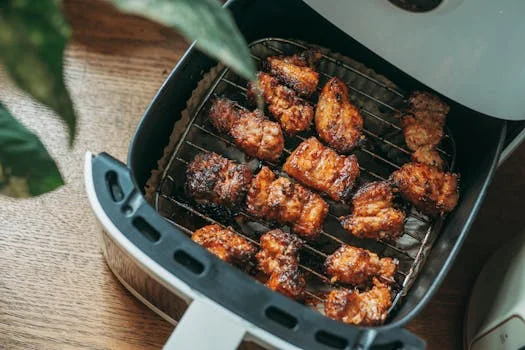
You pulled a recipe off the internet, preheated your air fryer, tossed in the chicken thighs at the same temperature the recipe called for, and twenty minutes later you had charred skin and a cold center. Sound familiar? Air fryers cook faster and hotter than conventional ovens, but most recipes still assume you are using a standard oven. The adjustment is not complicated once you know the rules, but getting those rules wrong means wasted food and frustration.
This guide walks through exactly how air fryer cooking differs from oven cooking, the two adjustments you need to make every time, and a free tool that handles the math so you do not have to memorize conversion tables.
Why Air Fryers Cook Differently Than Ovens
Air fryers are small convection ovens. A heating element sits at the top, and a powerful fan circulates hot air at high speed around the food. That rapid air circulation is what gives air-fried food its crispy exterior — but it also means the effective cooking temperature inside the basket is higher than what you set on the dial.
In a full-size oven, heat radiates from elements on the top and bottom, and unless you have a convection setting, the air is mostly still. Food cooks by absorbing radiant heat, which is a slower process. The temperature you set and the temperature surrounding the food are roughly the same.
The Convection Factor
A standard convection oven already cooks about 25 degrees Fahrenheit hotter than a conventional oven at the same setting, according to the USDA's food safety guidelines. Air fryers take this further because the fan speed is higher and the cooking chamber is much smaller. The hot air has less distance to travel and circulates more aggressively. The result: food cooks 20-30% faster and the effective heat is 25-50 degrees higher than the displayed temperature.
Why Size Matters
The compact basket also means food is closer to the heating element. A chicken breast in a full oven sits 8-12 inches from the top element. In most air fryers, that distance drops to 2-4 inches. This proximity amplifies browning — great for crispy skin, bad for delicate sauces or cheese toppings that burn before the interior finishes cooking.
This is why you cannot simply set your air fryer to the same temperature as the recipe and expect the same result. You need two adjustments every single time.
The Two-Rule Conversion Formula
The standard air fryer conversion follows two simple rules:
Rule 1: Lower the temperature by 25°F (about 15°C). If the oven recipe says 400°F, set your air fryer to 375°F. If the recipe calls for 425°F, drop to 400°F. This compensates for the more efficient heat transfer in the smaller chamber.
Rule 2: Reduce the cooking time by 20-25%. A recipe that takes 30 minutes in the oven will typically need 22-24 minutes in the air fryer. For shorter cook times under 15 minutes, lean toward a 20% reduction. For longer cook times, closer to 25%.
Here is how that looks in practice:
| Oven Setting | Air Fryer Temp | Oven Time | Air Fryer Time |
|---|---|---|---|
| 350°F | 325°F | 40 min | 30-32 min |
| 375°F | 350°F | 30 min | 22-24 min |
| 400°F | 375°F | 25 min | 19-20 min |
| 425°F | 400°F | 20 min | 15-16 min |
| 450°F | 425°F | 15 min | 11-12 min |
These are baseline numbers. The actual time depends on food thickness, whether items are frozen, and how full the basket is. A single layer of french fries cooks faster than a crowded basket where pieces overlap.
Using a Converter Tool
Rather than doing the math and adjusting for food type every time, I use a free air fryer converter that does this automatically. You enter the oven temperature and cook time from your recipe, select the type of food, and it gives you the adjusted air fryer settings. It also accounts for food-specific factors — frozen items need different adjustments than fresh ones, and proteins handle the heat differently than vegetables.
The tool shows a side-by-side comparison of energy use too, which is a nice bonus if you are curious about how much cheaper air frying is compared to running a full-size oven.
Food-Specific Adjustments That Most Guides Skip
The two-rule formula works for most situations, but certain foods need extra attention.
Proteins With Skin
Chicken thighs, drumsticks, and skin-on breasts benefit from starting at the standard converted temperature for the first 75% of cook time, then bumping the air fryer up by 25°F for the last few minutes. This finishes crisping the skin without overcooking the meat. A food safety thermometer is essential here — pull chicken at 165°F internal, regardless of how the skin looks.
Baked Goods
Muffins, cookies, and small cakes need a gentler approach. Drop the temperature by 30-35°F instead of 25°F, and check doneness 3-4 minutes early. The top browns fast in an air fryer, which can make a muffin look done while the center is still raw batter. Silicone liners help moderate the heat on the bottom.
According to King Arthur Baking, convection baking works well for cookies and scones but struggles with delicate cakes that need even, gentle heat — the same applies to air fryers, amplified by the smaller space.
Frozen Foods
Frozen items are where air fryers really shine, but the conversion math changes. Most frozen food packaging already accounts for conventional oven cooking. When converting: lower the temperature by only 15-20°F (frozen items need more heat to overcome the cold start) and reduce time by 15-20%. Check halfway through and shake or flip for even cooking.
Vegetables
Root vegetables like potatoes, carrots, and sweet potatoes do well with the standard 25°F reduction. Lighter vegetables — broccoli, zucchini, asparagus — need a shorter cook time than the formula suggests. Start checking at 60% of the converted time. A light coat of oil prevents drying out, which happens faster in the aggressive airflow.
Reheating Leftovers
This is where air fryers genuinely outperform microwaves. Pizza, fried chicken, fries, and anything with a crispy exterior comes back to life in an air fryer at 325-350°F for 3-5 minutes. No conversion math needed — just keep the temperature moderate and check frequently. The circulating air re-crisps the exterior while warming the interior evenly, which a microwave cannot do. For casseroles and saucy leftovers, cover with foil for the first half of reheating to prevent the top from drying out, then remove the foil for the final minute or two.
Fish and Seafood
Thin fillets like tilapia and sole cook extremely fast in an air fryer — often 6-8 minutes total at 375°F. The conversion from oven recipes should reduce time by closer to 30% rather than the standard 20-25%, because thin fish dries out quickly in the intense airflow. Thicker cuts like salmon steaks are more forgiving and follow the standard formula. Pat fish dry before cooking and use a light oil spray to promote browning without sticking.
Five Mistakes That Ruin Air Fryer Results
Overcrowding the basket. Air fryers work by circulating air around every surface of the food. Stack things on top of each other and the air cannot reach the bottom layer. Cook in batches if you have to. A single layer with small gaps between pieces produces the best results.
Skipping the preheat. Most air fryers reach temperature in 3-5 minutes. Skipping the preheat means the first few minutes of cook time are wasted on warming up, which throws off your timing. Always preheat unless you are cooking something very forgiving, like reheating pizza.
Not flipping or shaking midway. The top of food gets more heat than the bottom in most air fryer designs. Flip proteins halfway through. Shake the basket for fries, vegetables, and small items. This is non-negotiable for even cooking.
Using too much oil. One of the benefits of air frying is needing less oil. But some recipes converted from deep-frying call for coating food in oil. In an air fryer, excess oil drips to the bottom, smokes, and can make food soggy instead of crispy. A light spray or brush is all you need.
Ignoring the smoke point. Olive oil smokes at around 375°F. If your air fryer is set to 400°F and you coated food in olive oil, you will get smoke and off flavors. Use avocado oil, refined coconut oil, or another high-smoke-point oil for air fryer cooking above 375°F.
More Kitchen Tools and Resources
If you are converting oven recipes regularly, a few other tools pair well with the air fryer converter:
- Recipe Scaler — adjust ingredient quantities when halving or doubling a recipe for the smaller air fryer portions
- Cooking Unit Converter — convert between grams and cups when working with international recipes
- Meat Roasting Calculator — useful for verifying internal temperature targets and rest times when air-frying roasts
For deeper reading on convection cooking science, the Serious Eats guide to convection ovens covers the physics behind fan-assisted cooking. The USDA FoodKeeper app is also worth checking for storage times if you are batch-cooking air fryer meals for the week.
Whether you are converting a family casserole recipe or trying to get frozen wings to come out right, the adjustment is always the same starting point: lower the temperature, reduce the time, and keep an eye on things the first time you try a new recipe. The free air fryer converter takes the guesswork out of that first step, and after a few batches you will start to get a feel for how your specific model handles different foods.